

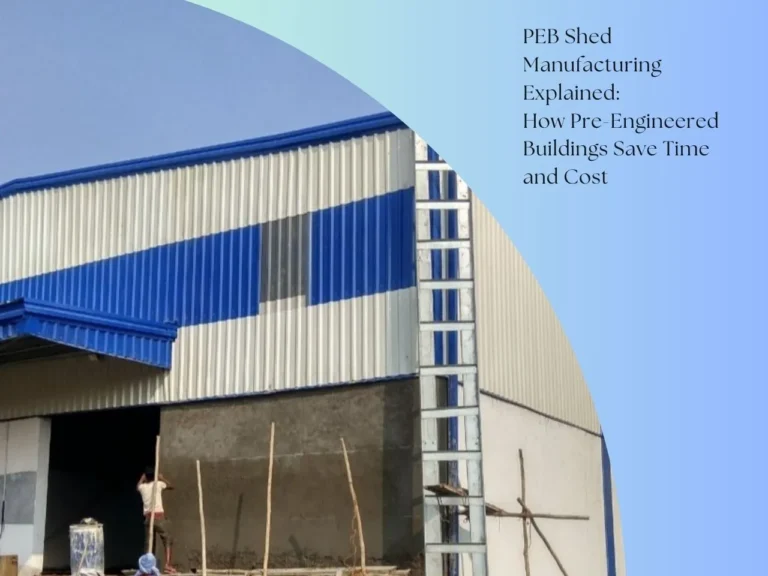
PEB Shed Manufacturing Explained: How Pre-Engineered Buildings Save Time and Cost
In today’s fast-moving industrial and infrastructure landscape, businesses need construction solutions that are faster, smarter, and more cost-effective. This is where Pre-Engineered Buildings (PEB) have emerged as a preferred choice. From warehouses and factories to logistics hubs and industrial sheds, PEB shed manufacturing is transforming how modern infrastructure is built.
This blog explains what PEB shed manufacturing is and how pre-engineered buildings help organizations significantly save time and reduce overall project costs.
What Is PEB Shed Manufacturing?
PEB shed manufacturing is a construction approach where building components are designed, engineered, fabricated, and quality-checked in a factory before being transported to the project site for assembly.
Unlike conventional construction, where most work happens on-site, PEB systems rely on:
- Pre-designed structural steel frames
- Factory-fabricated components
- Bolt-connected assembly at site
This method ensures higher accuracy, faster execution, and consistent quality.
How Pre-Engineered Buildings Save Time
1. Faster Design and Engineering
PEB structures are designed using advanced engineering software that optimizes steel usage and structural performance. Since designs follow standardized yet customizable modules, the design phase is completed much faster compared to traditional construction.
2. Parallel Processes
In PEB projects, foundation work and building fabrication happen simultaneously. While civil foundations are prepared at site, the steel structure is manufactured in the factory—significantly reducing total project duration.
3. Quick On-Site Installation
Since components arrive pre-cut, pre-drilled, and pre-finished, on-site erection becomes a bolt-and-assemble process. This eliminates delays caused by on-site fabrication, weather dependency, and labor inefficiencies.
4. Predictable Timelines
PEB shed manufacturing follows a structured workflow with defined timelines, allowing better planning and faster project handover.
How PEB Sheds Reduce Overall Costs
1. Optimized Steel Usage
PEB structures are engineered to use steel only where it is structurally required. Tapered sections and optimized designs reduce excess material, directly lowering raw material costs.
2. Lower Labor Expenses
Minimal on-site fabrication reduces the need for skilled labor over long periods. Faster installation also cuts labor costs and associated site expenses.
3. Reduced Construction Waste
Factory-controlled manufacturing ensures precise cutting and minimal material wastage, unlike traditional construction where waste levels are significantly higher.
4. Lower Maintenance Costs
PEB sheds use high-quality steel, protective coatings, and precision fabrication, resulting in structures that are durable, corrosion-resistant, and require less maintenance over time.
5. Energy-Efficient Design Options
PEB buildings can easily integrate insulation, natural lighting, and ventilation systems, helping businesses reduce long-term operational and energy costs.
Key Applications of PEB Sheds
Pre-engineered buildings are widely used across industries, including:
- Industrial sheds and factories
- Warehouses and logistics centers
- Manufacturing plants
- Cold storage facilities
- Commercial and infrastructure projects
Their flexibility and scalability make them ideal for both small and large industrial developments.
Why Businesses Prefer PEB Over Conventional Construction
- Faster project completion
- Cost predictability and budget control
- Superior structural quality
- Design flexibility and scalability
- Long-term operational savings
As industries continue to expand and modernize, PEB shed manufacturing provides a future-ready construction solution that aligns with speed, efficiency, and sustainability.
Final Thoughts
PEB shed manufacturing is not just an alternative to conventional construction—it is a smarter and more efficient approach that helps businesses save valuable time and control costs without compromising on quality or performance.
By choosing pre-engineered buildings, organizations gain faster execution, optimized investment, and durable infrastructure designed for long-term growth.