


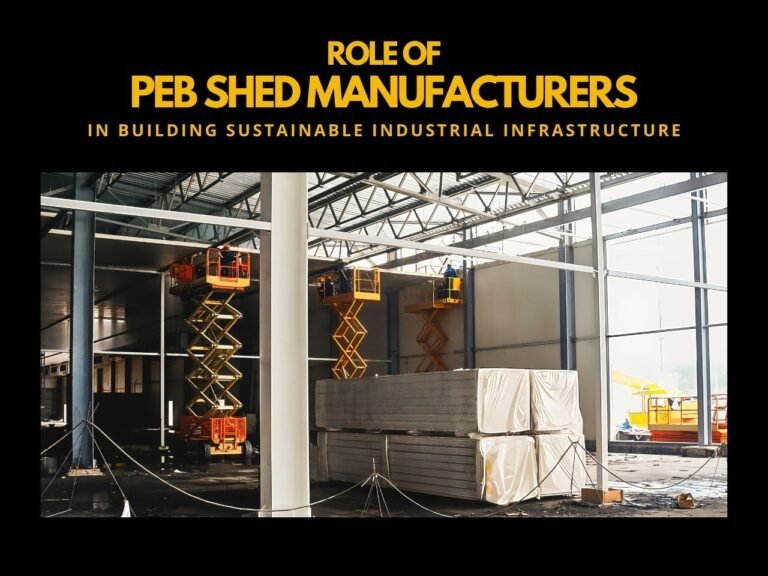
Role of PEB Shed Manufacturers in Building Sustainable Industrial Infrastructure
Sustainability is no longer optional in industrial development—it is a strategic necessity. As industries expand across India, the focus has shifted toward infrastructure that is not only strong and scalable but also environmentally responsible and resource-efficient.
In this transformation, PEB shed manufacturers are playing a vital role. Through optimized engineering, controlled manufacturing processes, and efficient construction methods, they are helping industries build sustainable industrial infrastructure without compromising performance or profitability.
This blog explores how PEB shed manufacturers contribute to environmentally responsible and future-ready industrial growth.
Understanding Sustainable Industrial Infrastructure
Sustainable industrial infrastructure refers to buildings designed to:
- Minimize environmental impact
- Optimize material usage
- Reduce energy consumption
- Ensure long-term durability
- Lower lifecycle costs
Pre-Engineered Buildings (PEB) align naturally with these objectives due to their design philosophy and manufacturing approach.
1. Optimized Steel Usage Reduces Material Waste
One of the primary advantages of PEB systems is structural optimization.
PEB shed manufacturers use advanced engineering software to calculate:
- Exact load requirements
- Steel section thickness
- Span and structural weight
Unlike conventional construction, where excess material may be used for safety margins, PEB systems use steel only where necessary.
This precision-driven approach significantly reduces raw material consumption and construction waste.
2. Factory-Controlled Manufacturing Enhances Efficiency
Traditional construction generates significant on-site waste due to cutting, rework, and material handling.
In contrast, PEB shed manufacturers operate in controlled factory environments, ensuring:
- Accurate cutting and fabrication
- Minimal material wastage
- Consistent quality control
- Reduced rework
This controlled process reduces environmental impact and enhances overall resource efficiency.
3. Faster Construction Means Lower Environmental Impact
Speed is not just an economic advantage—it is also an environmental one.
PEB sheds are completed faster because:
- Fabrication and site work run simultaneously
- Components arrive pre-engineered
- Installation is efficient
Shorter construction timelines mean:
- Reduced machinery operation hours
- Lower fuel consumption
- Minimal site disturbance
This contributes to reduced carbon emissions during construction.
4. Energy-Efficient Design Capabilities
PEB sheds can be designed with energy efficiency in mind.
Manufacturers integrate:
- Insulated roofing systems
- Reflective panels
- Natural lighting through skylights
- Ridge ventilation systems
- Solar panel compatibility
These features help industries reduce long-term electricity consumption and operational costs.
5. Recyclable and Reusable Materials
Steel, the primary material used in PEB sheds, is highly recyclable.
PEB structures offer:
- Recyclable structural components
- Potential for disassembly and relocation
- Reduced demolition waste
This makes PEB sheds a sustainable option compared to concrete-heavy conventional buildings.
6. Lower Lifecycle Maintenance Requirements
Durability is a key component of sustainability.
PEB shed manufacturers apply protective coatings and corrosion-resistant finishes that:
- Extend structural lifespan
- Reduce maintenance frequency
- Minimize material replacement
Longer-lasting structures reduce the need for repairs and additional material consumption over time.
7. Supporting Green Building Practices
Modern industrial infrastructure increasingly follows green building principles.
PEB shed manufacturers contribute by:
- Designing lightweight structures that require smaller foundations
- Reducing cement usage
- Offering insulated panel options
- Supporting renewable energy integration
These features align with environmental compliance standards and sustainable development goals.
8. Adaptability for Future Growth
Sustainable infrastructure must be adaptable.
PEB sheds are modular, allowing:
- Easy expansion
- Structural modifications
- Layout flexibility
This adaptability reduces the need for demolition and reconstruction as business needs evolve.
9. Reduced Construction Noise and Site Disturbance
Because most fabrication happens off-site, PEB construction generates:
- Less noise pollution
- Lower dust levels
- Reduced site congestion
This makes PEB sheds environmentally friendly, especially in urban or semi-urban industrial zones.
10. Supporting Industrial Sustainability Goals in India
India’s industrial policies emphasize responsible growth and environmental compliance.
PEB shed manufacturers support these goals by delivering infrastructure that is:
- Efficient
- Durable
- Scalable
- Resource-optimized
By combining engineering precision with sustainable practices, PEB manufacturers contribute directly to India’s long-term industrial sustainability.
Why Choosing the Right PEB Shed Manufacturer Matters
Sustainability depends on execution.
A reliable PEB shed manufacturer ensures:
- Optimized engineering
- High-quality materials
- Strict quality control
- Energy-efficient design integration
- Responsible manufacturing processes
The expertise of the manufacturer determines how effectively sustainability principles are implemented.
Conclusion
The role of PEB shed manufacturers extends beyond building industrial structures. They are strategic contributors to sustainable industrial infrastructure development.
Through optimized steel usage, factory-controlled fabrication, energy-efficient design integration, and recyclable materials, PEB sheds provide an environmentally responsible alternative to conventional construction.
As industries continue to expand, choosing a professional PEB shed manufacturer ensures infrastructure that supports not only operational growth—but also long-term environmental sustainability.
Sustainable growth begins with smart engineering, and PEB sheds are leading that transformation.