


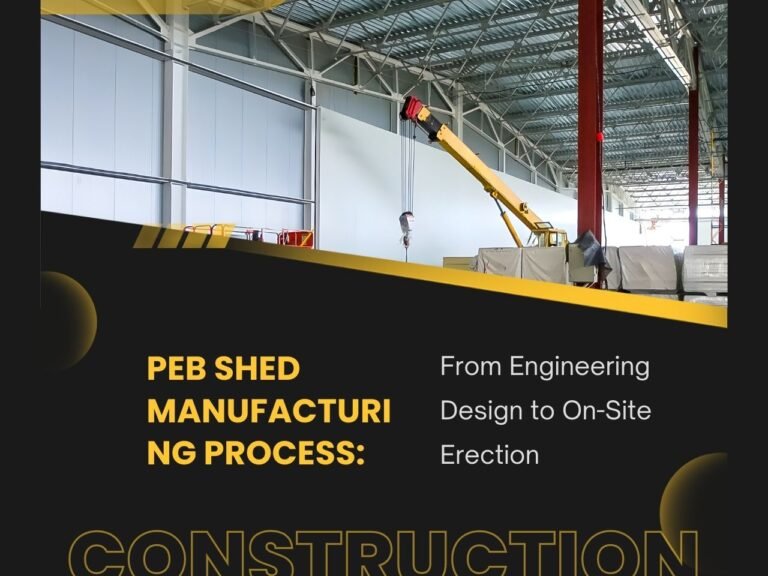
PEB Shed Manufacturing Process: From Engineering Design to On-Site Erection
The success of any industrial project depends on how efficiently the structure is planned, manufactured, and installed. In modern construction, the PEB (Pre-Engineered Building) shed manufacturing process has become the preferred approach for industrial sheds, warehouses, and logistics hubs due to its speed, precision, and cost efficiency.
Unlike traditional construction methods, PEB shed manufacturing follows a systematic, engineering-driven workflow—from initial structural design to final on-site erection. This blog explains each stage in detail to help you understand how professional PEB shed manufacturers deliver high-performance industrial structures.
What Is a PEB Shed?
A PEB shed is a steel building system designed using advanced structural software and fabricated in a factory-controlled environment. All structural components are pre-engineered and manufactured according to specific load and site conditions before being assembled at the project location.
This approach ensures better accuracy, reduced waste, and faster completion timelines.
Stage 1: Requirement Analysis & Project Planning
Every PEB shed project begins with a detailed consultation.
Key Considerations:
- Type of industrial use (warehouse, factory, storage, etc.)
- Site location and soil conditions
- Required span and height
- Wind and seismic zone
- Crane load requirements (if applicable)
- Future expansion needs
A reliable PEB shed manufacturer gathers these inputs to prepare a customized design plan.
Stage 2: Engineering Design & Structural Analysis
Engineering is the backbone of the PEB manufacturing process.
Using specialized structural design software, engineers calculate:
- Dead loads (self-weight of structure)
- Live loads (operational usage)
- Wind loads
- Seismic loads
- Equipment and crane loads
The structure is optimized to use steel efficiently while ensuring safety and durability.
Design Outputs Include:
- Primary framing (columns and rafters)
- Secondary members (purlins, girts, bracing)
- Roof and wall panel layouts
- Connection details
This stage ensures precision before fabrication begins.
Stage 3: Detailed Drawings & Client Approval
After structural design, detailed fabrication drawings are prepared.
These include:
- General arrangement drawings
- Anchor bolt layout
- Structural connection details
- Bill of materials
Client approval at this stage ensures alignment with project expectations and specifications.
Stage 4: Raw Material Procurement
Quality begins with material selection.
Reputable PEB shed manufacturers use:
- High-grade structural steel
- Certified fasteners and bolts
- Durable roofing and cladding materials
- Approved welding consumables
All materials undergo inspection before entering the fabrication line.
Stage 5: Precision Fabrication in Factory
Fabrication takes place in a controlled manufacturing facility using advanced machinery.
Key Fabrication Processes:
- Cutting steel plates to required sizes
- Welding built-up sections
- Drilling bolt holes with CNC machines
- Assembly of structural components
Factory-controlled fabrication ensures dimensional accuracy and consistent quality.
Stage 6: Surface Treatment & Protective Coating
To enhance durability and corrosion resistance, structural components undergo:
- Shot blasting for surface cleaning
- Primer application
- Protective paint coating
For projects in humid or coastal environments, additional anti-corrosion treatments may be applied.
This step increases the lifespan of the PEB shed.
Stage 7: Quality Inspection & Testing
Before dispatch, components undergo strict quality checks:
- Weld inspection
- Dimensional verification
- Coating thickness measurement
- Structural compliance testing
Quality control ensures that every part meets engineering and safety standards.
Stage 8: Transportation & Site Preparation
Once fabrication is complete, components are carefully packed and transported to the project site.
Meanwhile, civil work progresses at the site, including:
- Excavation
- Foundation preparation
- Anchor bolt placement
- Concrete curing
Parallel site preparation significantly reduces total project duration.
Stage 9: On-Site Erection & Assembly
This is the final and most visible stage of the PEB shed manufacturing process.
Installation typically involves:
- Erecting primary columns
- Fixing rafters and roof beams
- Installing bracing systems
- Attaching secondary members
- Fixing roof and wall panels
Since components are pre-engineered and pre-drilled, on-site assembly is faster and more accurate than conventional construction.
Professional erection teams ensure proper alignment, secure connections, and structural stability.
Stage 10: Final Inspection & Handover
After installation:
- Structural alignment is verified
- Safety checks are conducted
- Finishing elements are installed
- Client inspection is completed
Once approved, the PEB shed is handed over—ready for industrial operations.
Why the PEB Manufacturing Process Is More Efficient
The structured approach offers several advantages:
✔ Faster Completion
Parallel execution reduces construction timelines.
✔ Cost Optimization
Optimized steel usage lowers material expenses.
✔ High Precision
Factory-controlled fabrication ensures accuracy.
✔ Scalability
Modular design allows easy expansion.
✔ Long-Term Durability
Protective coatings enhance structural life.
Importance of Choosing an Experienced PEB Shed Manufacturer
The quality of the final structure depends on the expertise of the manufacturer.
A reliable PEB shed manufacturer ensures:
- Accurate engineering design
- Modern fabrication facilities
- Strict quality control
- Skilled installation teams
- Timely project delivery
Experience and technical capability make the difference between an average structure and a high-performance industrial facility.
Conclusion
The PEB shed manufacturing process—from engineering design to on-site erection—is a well-coordinated system built on precision, efficiency, and quality control.
By combining advanced structural design, factory-based fabrication, and professional installation, PEB sheds provide a faster, stronger, and more cost-effective solution for industrial infrastructure.
For businesses planning industrial or warehouse construction, partnering with an experienced PEB shed manufacturer ensures that every stage—from design to delivery—is executed with excellence and reliability.