


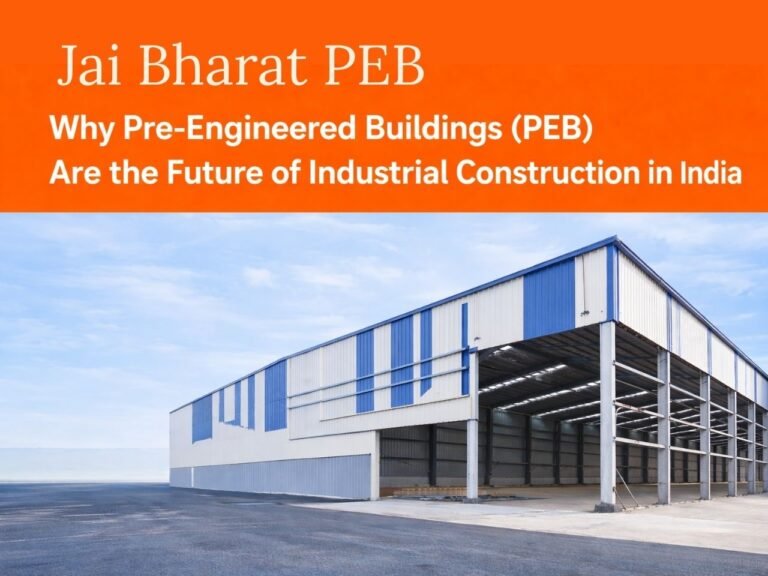
Why Pre-Engineered Buildings (PEB) Are the Future of Industrial Construction in India
Introduction
India’s industrial sector is undergoing rapid transformation, driven by initiatives like Make in India, increasing foreign investments, and the expansion of manufacturing and logistics hubs. As industries scale faster than ever, the need for efficient, cost-effective, and durable infrastructure has become critical.
This is where Pre-Engineered Buildings (PEB) are redefining the landscape of industrial construction. Compared to traditional construction methods, PEB structures offer unmatched advantages in terms of speed, flexibility, and performance—making them the future of industrial development in India.
What Are Pre-Engineered Buildings (PEB)?
Pre-Engineered Buildings (PEB) are steel structures that are designed, fabricated, and manufactured in a factory-controlled environment and then assembled at the project site.
These structures include:
- Primary framing (columns & rafters)
- Secondary members (purlins & girts)
- Roofing and wall cladding systems
- Accessories like skylights, ventilators, and insulation
PEB technology ensures precision engineering, reduced material wastage, and faster project completion.
Growing Demand for PEB in India
India’s infrastructure and industrial growth has created massive demand for:
- Warehouses and logistics parks
- Manufacturing plants
- Industrial sheds
- Cold storage units
- Commercial and institutional structures
With the rise of e-commerce, industrial corridors, and smart cities, businesses require scalable and quick construction solutions—making PEB the preferred choice across sectors.
Key Reasons Why PEB Is the Future of Industrial Construction
1. Faster Construction Time
One of the biggest advantages of PEB is speed.
- Components are pre-fabricated in factories
- On-site work is minimized
- Installation is faster and more efficient
Compared to traditional RCC construction, PEB structures can be completed in 30–50% less time, enabling businesses to start operations sooner.
2. Cost-Effective Solution
PEB structures significantly reduce overall project costs:
- Lower material wastage
- Reduced labor costs
- Faster project turnaround
- Optimized design reduces steel consumption
This makes PEB an ideal choice for industries looking to maximize ROI.
3. Design Flexibility and Customization
PEB buildings are highly customizable and adaptable to specific business requirements.
- Large clear spans for warehouses
- Custom heights and widths
- Expansion-friendly designs
- Integration of cranes and mezzanine floors
This flexibility allows industries to design structures tailored to their operational needs.
4. High Strength and Durability
PEB structures are engineered to withstand:
- Heavy wind loads
- Seismic conditions
- Extreme weather environments
Using high-quality steel and advanced fabrication techniques ensures long-lasting performance with minimal maintenance.
5. Sustainable and Eco-Friendly Construction
Sustainability is a key factor driving modern construction choices.
PEB structures support green building practices by:
- Using recyclable steel
- Reducing construction waste
- Lowering energy consumption
- Supporting insulation for energy efficiency
This makes PEB an environmentally responsible construction solution.
6. Low Maintenance and Long-Term Performance
PEB buildings require minimal maintenance due to:
- Corrosion-resistant coatings
- High-quality materials
- Precision fabrication
This reduces long-term operational costs and ensures consistent performance over time.
7. Ideal for Industrial and Logistics Applications
PEB structures are widely used across industries such as:
- Manufacturing units
- Warehousing and logistics hubs
- Automobile industries
- FMCG and retail storage
- Pharma and food processing plants
Their ability to support large spans and heavy loads makes them ideal for industrial operations.
Role of PEB in India’s Industrial Growth
India is witnessing rapid expansion in industrial corridors such as:
- Delhi-Mumbai Industrial Corridor (DMIC)
- Dedicated Freight Corridors
- Smart Industrial Cities
- Logistics and warehousing clusters
PEB technology plays a crucial role in supporting this growth by enabling:
- Faster infrastructure development
- Scalable industrial expansion
- Efficient space utilization
As industries demand speed and efficiency, PEB solutions are becoming the backbone of modern industrial infrastructure.
Why Businesses Are Shifting to PEB
Companies across India are increasingly choosing PEB over traditional construction due to:
- Faster ROI
- Reduced project risks
- Better quality control
- Flexibility for future expansion
- Cost savings in both short and long term
PEB structures align perfectly with the needs of modern businesses that prioritize speed, scalability, and efficiency.
Jai Bharat PEB – Driving Innovation in Industrial Construction
At Jai Bharat PEB, we specialize in delivering high-quality Pre-Engineered Building solutions tailored to industrial, commercial, and infrastructure needs.
What Sets Us Apart:
- Advanced manufacturing facility
- Skilled engineering and design team
- End-to-end project execution
- Strict quality control processes
- Timely delivery and execution
From design to installation, we ensure precision, durability, and performance in every project.
Future of PEB in India
The future of industrial construction in India is undoubtedly aligned with PEB technology.
With increasing demand for:
- Faster project execution
- Sustainable infrastructure
- Cost optimization
- Scalable industrial solutions
PEB is set to dominate the construction industry in the coming years.
Government initiatives, infrastructure investments, and private sector growth will further accelerate the adoption of PEB structures across the country.
Conclusion
Pre-Engineered Buildings are transforming the way industrial infrastructure is designed and built in India. Their advantages in speed, cost, flexibility, and sustainability make them the ideal choice for modern construction needs.
As industries continue to evolve, PEB solutions will play a vital role in shaping India’s industrial future.