


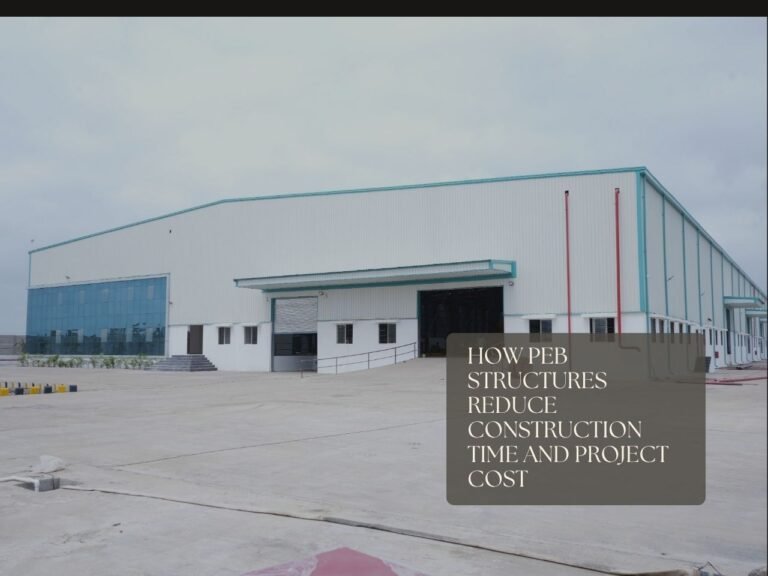
How PEB Structures Reduce Construction Time and Project Cost
In the modern construction ecosystem, businesses are constantly seeking solutions that deliver speed, efficiency, and cost optimization. Pre-Engineered Building (PEB) structures have emerged as a game-changing approach, especially for warehouses, factories, and industrial units. Unlike traditional construction methods, PEB structures are designed with precision and built for performance—significantly reducing both construction time and overall project costs.
This blog explores how PEB structures streamline the construction process and deliver substantial financial advantages.
PEB structures are engineered in a factory setting and assembled on-site using pre-fabricated components. Each element—columns, beams, roofing systems—is designed with advanced software to ensure precision and efficiency.
This approach eliminates many uncertainties associated with conventional construction, such as material delays and on-site errors.
1. Faster Project Execution Through Pre-Fabrication
One of the primary reasons PEB structures reduce construction time is off-site manufacturing.
How It Works:
- Structural components are fabricated simultaneously while site preparation is underway
- No need for extensive on-site casting or curing
- Components arrive ready for assembly
Impact:
- Construction timelines are reduced by up to 40–60%
- Faster project completion leads to quicker operational start
For industries, this means reduced downtime and faster revenue generation.
2. Reduced Labor Dependency and Costs

Traditional construction requires large labor teams for activities like masonry, plastering, and curing. In contrast, PEB construction focuses on assembly rather than building from scratch.
Key Benefits:
- Smaller workforce required
- Reduced labor expenses
- Lower risk of labor-related delays
This streamlined workforce approach directly contributes to cost savings.
3. Minimal Material Wastage
PEB structures are designed using advanced engineering tools that optimize material usage.
Advantages:
- Precise steel cutting and fabrication
- Minimal on-site waste generation
- Efficient use of raw materials
In traditional construction, material wastage can significantly inflate costs. PEB eliminates this inefficiency, ensuring better budget control.
4. Lower Foundation Costs
PEB structures are relatively lightweight compared to conventional RCC buildings. This results in simplified foundation requirements.
Cost Impact:
- Reduced excavation work
- Lower concrete consumption
- Faster foundation completion
A lighter structure means significant savings right from the base of the project.
5. Shorter Construction Cycle Reduces Overheads
Time is money in construction. Longer project durations lead to increased overhead costs such as:
- Site management expenses
- Equipment rentals
- Administrative costs
With PEB structures:
- Faster completion reduces these ongoing expenses
- Projects stay within budget and schedule
This efficiency makes PEB an economically superior choice for industrial development.
6. Enhanced Design Accuracy Minimizes Rework
PEB buildings are designed using advanced software and engineering tools, ensuring high precision.
Benefits:
- Accurate component dimensions
- Reduced chances of on-site errors
- Minimal rework and delays
Rework is one of the biggest contributors to cost overruns in traditional construction—PEB effectively eliminates this risk.
7. Faster Installation with Modular Assembly
PEB structures follow a bolt-together assembly system, which simplifies installation.
Key Highlights:
- Components are pre-drilled and ready to fit
- Quick erection using cranes and basic equipment
- Reduced dependency on skilled labor for complex tasks
This modular approach accelerates project timelines while maintaining structural integrity.
8. Scalability Without Major Cost Disruptions
PEB structures are designed with future expansion in mind.
Advantages:
- Easy to add extensions or additional bays
- No need for major demolition or redesign
- Cost-effective upgrades
Businesses can scale operations without incurring heavy reconstruction costs.
9. Reduced Maintenance and Lifecycle Costs
Beyond initial construction, PEB structures continue to save costs over time.
Long-Term Benefits:
- Corrosion-resistant coatings
- Durable steel components
- Low maintenance requirements
This ensures lower lifecycle costs compared to traditional buildings.
Conclusion
PEB structures have redefined construction efficiency by combining speed, precision, and cost-effectiveness. From reduced labor and material waste to faster execution and lower overheads, every aspect of PEB construction is optimized for performance.
For businesses planning warehouses, factories, or industrial units, choosing PEB is not just about saving time—it’s about making a strategic investment that maximizes returns and minimizes risks.
As industries continue to evolve, PEB structures stand out as a smart, scalable, and future-ready construction solution.