


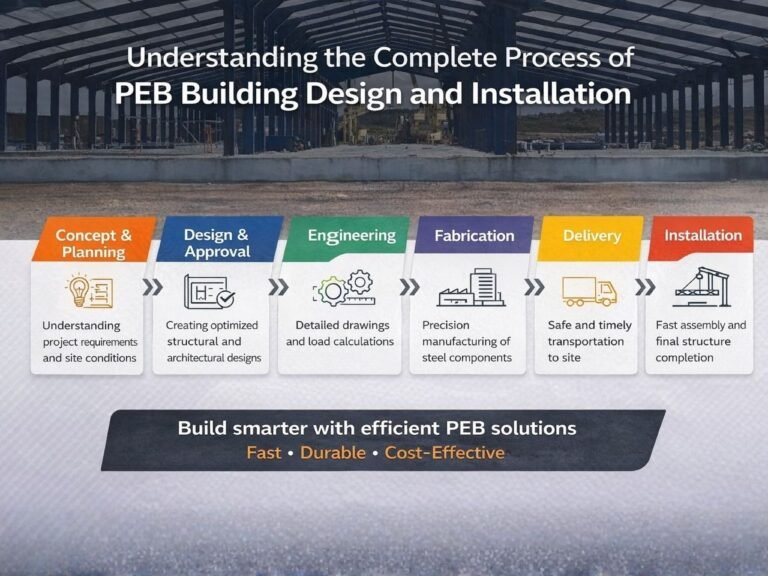
Understanding the Complete Process of PEB Building Design and Installation
Introduction
What if you could construct a large warehouse or industrial facility in nearly half the time—and at a significantly lower cost—without compromising quality or durability?
That’s exactly what Pre-Engineered Buildings (PEB) offer. Across industries—from logistics and manufacturing to retail and aviation—PEB structures are redefining how modern infrastructure is built.
The complete process of PEB building design and installation is not just about assembling steel structures. It’s a well-planned, highly engineered journey that begins with concept design and ends with a fully functional, ready-to-use facility.
In this guide, you’ll explore every stage of the PEB process in a simple, easy-to-understand way. Whether you’re a business owner, project manager, or simply curious, this article will help you understand how PEB buildings are designed, manufactured, and installed efficiently.
What Is a PEB Building?

6
A Pre-Engineered Building (PEB) is a structure built using pre-designed and factory-manufactured components. These parts are transported to the site and assembled using bolts and connections.
Key Features:
- Steel is the primary material
- Designed using advanced engineering software
- Custom-built based on usage and environment
- Faster and more efficient than traditional construction
PEB buildings are widely used for:
- Warehouses
- Factories
- Commercial spaces
- Aircraft hangars
Why Understanding the PEB Building Design and Installation Process Matters
Knowing the full process helps you:
- Make better project decisions
- Avoid delays and cost overruns
- Choose the right manufacturer or contractor
- Plan timelines more effectively
In markets like the USA and globally, where efficiency and speed are critical, understanding this process gives you a competitive advantage.
Step 1: Requirement Analysis and Planning
Every successful PEB project starts with a clear understanding of requirements.
What Happens Here:
- Identifying building purpose (warehouse, factory, etc.)
- Determining size, height, and layout
- Understanding load conditions (wind, seismic, snow)
- Budget and timeline planning
This stage sets the foundation for the entire project.
Step 2: Conceptual Design and Engineering

6
Once requirements are defined, engineers create a conceptual design.
Key Activities:
- 3D modeling using software like Tekla or STAAD
- Structural calculations for safety and efficiency
- Optimization of steel usage
- Layout planning for space utilization
This stage ensures the building is both safe and cost-effective.
Step 3: Detailed Design and Drawings
After concept approval, detailed drawings are created.
Includes:
- Structural drawings
- Connection details
- Fabrication drawings
- Anchor bolt plans
These drawings guide the manufacturing and installation teams.
Step 4: Factory Fabrication of Components
This is where the real transformation begins.
Process:
- Steel cutting using CNC machines
- Welding and shaping of components
- Surface treatment (painting or galvanizing)
- Quality inspection
Benefits:
- High precision
- Minimal material waste
- Faster production
Unlike traditional construction, most work happens off-site.
Step 5: Transportation and Logistics
Once components are ready, they are transported to the construction site.
Important Factors:
- Proper packaging to avoid damage
- Efficient logistics planning
- Timely delivery
Delays at this stage can impact the project timeline, so coordination is critical.
Step 6: Site Preparation and Foundation Work
While fabrication happens in the factory, site work progresses simultaneously.
Activities:
- Land clearing and leveling
- Excavation
- Foundation construction
- Anchor bolt placement
Because PEB structures are lightweight, foundation requirements are simpler and faster.
Step 7: Erection of Steel Structure
This is one of the most exciting stages—where the building starts to take shape.
Process:
- Installation of columns
- Placement of rafters
- Connecting beams and frames
- Bolting and alignment
Key Advantages:
- Quick assembly
- Reduced labor requirement
- High accuracy
The modular nature of PEB makes erection fast and efficient.
Step 8: Roofing and Cladding Installation

Once the structure is up, external covering is added.
Includes:
- Roof panels
- Wall cladding
- Insulation systems
- Skylights and ventilators
This stage protects the building from environmental elements.
Step 9: Finishing and Accessories
Now the building moves closer to completion.
Additions:
- Doors and windows
- Electrical systems
- Flooring
- Mezzanine floors (if required)
These elements make the building functional and ready for use.
Step 10: Quality Checks and Final Inspection

6
Before handover, thorough inspections are conducted.
Checks Include:
- Structural stability
- Alignment and connections
- Material quality
- Safety compliance
This ensures the building meets all standards.
Step 11: Handover and Project Completion
After successful inspection:
- The building is handed over to the client
- Documentation and warranties are provided
- The facility is ready for operations
Benefits of the Complete PEB Building Design and Installation Process
1. Speed
Projects are completed faster due to parallel processes.
2. Cost Efficiency
Reduced labor, waste, and time lower overall costs.
3. Precision
Factory fabrication ensures accuracy.
4. Scalability
Easy to expand in the future.
PEB vs Traditional Construction: A Quick Comparison
| Factor | PEB | Traditional |
|---|---|---|
| Construction Time | Fast | Slow |
| Cost | Lower | Higher |
| Flexibility | High | Limited |
| Maintenance | Low | High |
Real-World Applications Across Industries
PEB buildings are used globally in:
- Logistics hubs in the USA
- Manufacturing plants in Europe
- Warehousing in India
- Commercial spaces worldwide
Their adaptability makes them a universal solution.
Common Challenges and How to Avoid Them
Challenges:
- Poor planning
- Choosing inexperienced contractors
- Delayed logistics
Solutions:
- Work with experienced manufacturers
- Plan timelines clearly
- Ensure quality checks at every stage
Expert Insight
Industry experts often emphasize that:
“PEB construction is not just about speed—it’s about smart engineering and long-term value.”
Understanding the Complete Process of PEB Building Design and Installation – Frequently Asked Questions
1. How long does a PEB building take to construct?
Most projects are completed within weeks to a few months, depending on size.
2. Is PEB construction cheaper than traditional methods?
Yes, due to reduced labor, faster timelines, and optimized materials.
3. Can PEB buildings be customized?
Absolutely. Designs can be tailored to specific needs.
4. Are PEB buildings durable?
Yes, they are designed to withstand harsh weather conditions.
5. What industries use PEB structures?
Warehousing, manufacturing, aviation, retail, and more.
Conclusion
The complete process of PEB building design and installation is a streamlined, efficient, and highly engineered journey. From planning and design to fabrication and final assembly, every step is optimized for speed, precision, and cost-effectiveness.
As industries continue to demand faster and smarter construction solutions, PEB buildings stand out as the future of infrastructure.
If you’re planning your next industrial or commercial project, understanding this process can help you make informed, strategic decisions.