


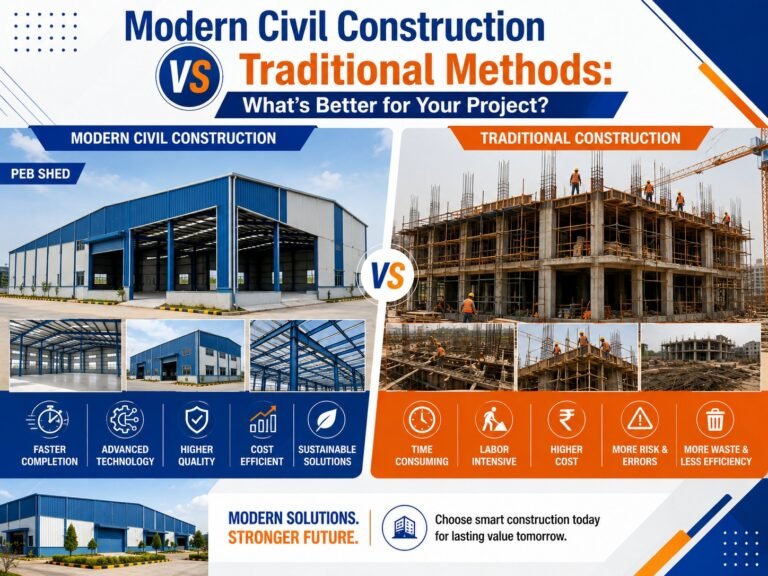
Modern Civil Construction vs Traditional Methods: What’s Better for Your Project?
Have you ever driven past a construction site and wondered why some buildings rise within months while others seem to take years? The answer often lies in the construction method being used. Across India and around the world, the construction industry is changing rapidly. Developers, factory owners, warehouse operators, and commercial builders are now choosing smarter and faster techniques to complete projects on time and within budget.
For decades, traditional construction methods dominated the industry. Brick-by-brick structures, manual labor, and lengthy project timelines were considered normal. But today, modern civil construction techniques such as pre-engineered buildings (PEB), steel structures, modular systems, and advanced project management tools are transforming the way projects are built.
So, which approach is better for your project? Should you stick with traditional methods or move toward modern civil construction solutions?
This article explores the key differences, advantages, challenges, and practical applications of both systems so you can make the right decision for your next project.
Understanding Modern Civil Construction
Modern civil construction refers to advanced building techniques that use technology, engineered materials, automation, and efficient project planning to complete construction projects faster and more effectively.
Unlike traditional methods that depend heavily on manual labor and on-site fabrication, modern construction focuses on precision engineering, factory-manufactured components, and streamlined execution.
Common examples include:
- Pre-engineered buildings (PEB)
- Steel structure construction
- Modular construction
- Smart infrastructure systems
- Advanced concrete technology
- Sustainable building materials
Modern civil construction is widely used for:
- Industrial sheds
- Warehouses
- Commercial buildings
- Logistics parks
- Airports
- Factories
- Retail spaces
- Infrastructure projects
The main goal is simple: reduce construction time while improving quality and durability.
What Are Traditional Construction Methods?
Traditional construction methods involve conventional building practices that have been used for generations. These methods mainly rely on brick masonry, reinforced cement concrete (RCC), timber work, and manual construction techniques.
In India, traditional construction is still commonly used for:
- Residential homes
- Small commercial buildings
- Local infrastructure
- Rural projects
Traditional construction usually includes:
- On-site material preparation
- Brick-and-mortar walls
- Concrete casting
- Labor-intensive work
- Longer project timelines
While these methods have stood the test of time, they often face challenges related to speed, cost control, and scalability.
The Evolution of Construction in India
India’s construction sector is growing rapidly due to urbanization, industrial expansion, and infrastructure development. With increasing demand for factories, warehouses, data centers, and commercial spaces, builders are now under pressure to complete projects faster.
Earlier, projects could take several years without major concerns. Today, businesses want operational facilities within months.
This shift has increased the popularity of modern civil construction solutions such as:
- PEB sheds
- Steel fabrication structures
- Industrial warehouse systems
- Fast-track construction models
Government initiatives like Make in India, smart cities, industrial corridors, and logistics development have also accelerated demand for modern infrastructure.
Speed of Construction: Which Method Is Faster?
Modern Civil Construction
Modern methods are significantly faster because many components are manufactured off-site and assembled quickly at the construction location.
For example:
- Steel structures are pre-designed
- Components are fabricated in factories
- Installation happens rapidly on-site
A warehouse project that may take 12–18 months using traditional methods can often be completed within 4–8 months using PEB construction.
Benefits of Faster Construction
- Reduced labor costs
- Faster business operations
- Lower project delays
- Better return on investment
- Reduced site management expenses
Traditional Construction
Traditional construction usually requires:
- Extensive curing time
- Manual brickwork
- On-site fabrication
- Multiple construction stages
Weather conditions can also delay progress significantly.
Result
When speed matters, modern civil construction is usually the better choice.
Cost Comparison Between Modern and Traditional Construction
Cost is one of the biggest deciding factors for any project owner.
Initial Construction Cost
Traditional construction may appear cheaper initially for small projects because materials like bricks and cement are locally available.
However, modern construction often becomes more economical for:
- Large industrial projects
- Warehouses
- Commercial facilities
- Long-span structures
Long-Term Cost Savings
Modern civil construction reduces costs through:
- Faster completion
- Lower maintenance
- Reduced material waste
- Better energy efficiency
- Lower labor dependency
Traditional buildings may involve:
- Higher repair costs
- Structural maintenance
- Increased construction delays
Hidden Costs
Traditional methods often face hidden expenses such as:
- Labor shortages
- Material wastage
- Rework
- Time overruns
Modern construction focuses more on precision, reducing unexpected costs.
Strength and Durability of Structures
Traditional Construction Durability
Traditional RCC and brick buildings are known for durability when constructed properly. Many historical structures built with conventional methods still exist today.
However, durability depends heavily on:
- Workmanship quality
- Material consistency
- Environmental conditions
Modern Construction Strength
Modern steel structures and PEB systems are designed using advanced engineering software. These systems are tested for:
- Wind resistance
- Earthquake safety
- Load-bearing performance
- Weather durability
Modern structures also use corrosion-resistant coatings and high-grade steel.
Key Advantage
Modern civil construction offers higher precision and predictable structural performance.
Design Flexibility and Customization
One major advantage of modern construction is flexibility.
Modern Construction Design Benefits
PEB and steel structures allow:
- Large column-free spaces
- Flexible layouts
- Easy future expansion
- Custom architectural designs
This makes them ideal for:
- Warehouses
- Factories
- Sports arenas
- Aircraft hangars
- Commercial showrooms
Traditional Construction Limitations
Brick-and-mortar structures may face limitations regarding:
- Span width
- Expansion possibilities
- Structural modifications
Changes during construction can also increase costs and delays.
Environmental Impact and Sustainability
Sustainability is becoming increasingly important worldwide.
Modern Construction and Sustainability
Modern civil construction supports eco-friendly building practices through:
- Recyclable steel materials
- Reduced construction waste
- Energy-efficient systems
- Lower water consumption
- Faster site cleanup
Many industrial companies now prefer green building solutions to meet environmental standards.
Traditional Construction Environmental Challenges
Traditional construction often produces:
- Higher material wastage
- Increased dust pollution
- More water usage
- Greater environmental impact
Brick kilns also contribute significantly to pollution.
Labor Dependency and Workforce Challenges
Traditional Construction
Traditional methods rely heavily on skilled labor.
Challenges include:
- Labor shortages
- Rising wages
- Inconsistent workmanship
- Delayed execution
India’s construction industry frequently faces workforce management issues.
Modern Civil Construction
Modern systems reduce labor dependency through:
- Factory automation
- Pre-manufactured components
- Faster assembly methods
This improves consistency and efficiency.
Safety Standards in Modern vs Traditional Construction
Construction safety is a major concern on every project site.
Modern Construction Safety
Modern methods improve safety because:
- Less on-site fabrication is required
- Controlled factory environments reduce risks
- Faster assembly minimizes exposure time
Advanced equipment and technology also help maintain safety standards.
Traditional Construction Risks
Traditional projects may involve:
- Extensive scaffolding
- Manual handling
- On-site concrete mixing
- Higher accident risks
Safety largely depends on site supervision and worker training.
Best Applications for Modern Civil Construction
Modern construction works best for:
Industrial Projects
Factories and manufacturing units require large spaces and quick setup.
Warehouses and Logistics Parks
Modern warehouse construction focuses on speed and operational efficiency.
Commercial Buildings
Retail spaces and showrooms benefit from flexible layouts.
Infrastructure Projects
Airports, transport hubs, and industrial corridors increasingly use steel structures.
Agricultural Buildings
Cold storage facilities and processing units often prefer PEB systems.
Where Traditional Construction Still Works Well
Despite advancements, traditional construction remains useful for certain projects.
Residential Homes
Many homeowners still prefer brick-and-concrete houses due to familiarity and local availability.
Heritage Architecture
Traditional methods are often required for restoration projects.
Small-Scale Buildings
For compact structures, conventional methods may still be practical.
Rural Areas
In some regions, modern fabrication facilities may not be easily accessible.
Modern Civil Construction vs Traditional Methods: A Side-by-Side Comparison
| Feature | Modern Civil Construction | Traditional Construction |
|---|---|---|
| Construction Speed | Fast | Slow |
| Labor Dependency | Lower | Higher |
| Cost Efficiency | Better long-term | Often higher long-term |
| Design Flexibility | High | Moderate |
| Sustainability | Eco-friendly | More waste generation |
| Safety Standards | Improved | Moderate |
| Maintenance | Lower | Higher |
| Scalability | Excellent | Limited |
| Quality Consistency | High precision | Depends on workmanship |
| Industrial Suitability | Excellent | Limited |
How Technology Is Changing Construction
Technology plays a major role in modern civil construction.
Some major innovations include:
Building Information Modeling (BIM)
Helps improve planning accuracy and project coordination.
Drones and Site Monitoring
Improve inspection and progress tracking.
Smart Materials
Advanced materials improve energy efficiency and durability.
Automation
Factory-controlled fabrication improves quality consistency.
AI and Data Analytics
Used for project forecasting and resource optimization.
Technology reduces delays, improves accuracy, and enhances overall project management.
Choosing the Right Construction Method for Your Project
The right method depends on your specific project goals.
Ask yourself:
- How quickly does the project need completion?
- What is the project budget?
- Is future expansion important?
- What type of structure is required?
- What are the long-term maintenance expectations?
Choose Modern Civil Construction If:
- You need faster project delivery
- You want large-span industrial spaces
- Long-term efficiency matters
- Sustainability is important
- You need scalable infrastructure
Choose Traditional Construction If:
- The project is residential
- Architectural tradition matters
- The structure is small-scale
- Local material use is preferred
Future Trends in Civil Construction
The future of construction is becoming smarter, faster, and more sustainable.
Key trends include:
- Smart factories
- Green buildings
- Modular construction
- Energy-efficient infrastructure
- AI-based project management
- Sustainable steel systems
India is expected to become one of the largest construction markets globally, increasing demand for modern building solutions.
Conclusion
Construction is no longer just about building walls and roofs. Today, it is about speed, efficiency, sustainability, safety, and long-term value.
Traditional construction methods have served the industry for generations and still remain useful for certain applications. However, modern civil construction is reshaping the future of industrial and commercial infrastructure.
For businesses looking to reduce timelines, improve operational efficiency, and build durable infrastructure, modern construction methods such as PEB systems and steel structures often provide a smarter solution.
The best choice depends on your project goals, budget, location, and long-term vision. By understanding the strengths and limitations of both approaches, project owners can make informed decisions that support successful construction outcomes.
As India continues to grow as a manufacturing and industrial hub, modern civil construction will likely become the preferred choice for future-ready infrastructure across the country and beyond.