


How PEB Sheds Reduce Construction Time and Project Costs
Imagine two companies planning to build a large industrial warehouse.
The first chooses traditional construction using brick, cement, and conventional steel structures. The second chooses a pre-engineered building (PEB) shed.
Six months later, one project is still under construction with delays, labor shortages, and rising material costs. The other is already operational and generating revenue.
That is the power of PEB construction.
In today’s competitive industrial landscape, businesses cannot afford delays, budget overruns, or inefficient construction methods. Whether it is a factory, warehouse, logistics hub, cold storage unit, or commercial facility, speed and cost efficiency directly impact profitability.
This is why PEB sheds are becoming the preferred choice across industries.
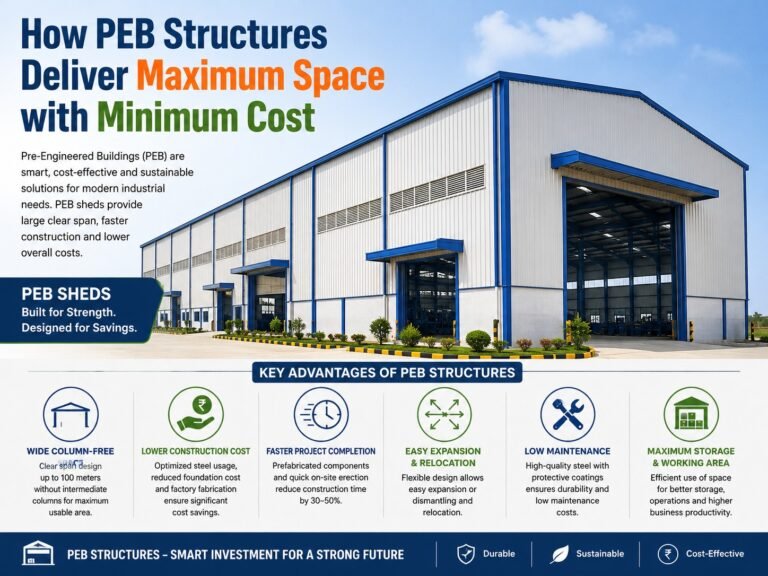
A modern PEB shed offers faster installation, reduced labor costs, lower material wastage, better structural efficiency, and long-term cost savings.
For industries looking to expand quickly, PEB sheds provide a smarter solution.
What Is a PEB Shed?
A PEB shed is a steel building designed, engineered, and fabricated in a factory before being assembled at the project site.
PEB stands for Pre-Engineered Building.
These structures are custom-designed to meet specific load, span, height, and operational requirements.
Common applications include:
- Industrial sheds
- Warehouse sheds
- Factory buildings
- Logistics centers
- Agricultural buildings
- Cold storage units
- Commercial spaces
Unlike traditional construction, most structural components are manufactured in advance.
This reduces on-site construction time significantly.
Why Are Businesses Choosing PEB Sheds?
Businesses choose PEB sheds because they are faster, cost-effective, scalable, and highly durable.
Key reasons include:
- Faster project completion
- Lower construction cost
- Reduced maintenance
- Better space utilization
- Flexible expansion
Modern industries need buildings that support operational growth without unnecessary delays.
PEB structures solve this challenge efficiently.
How PEB Sheds Reduce Construction Time
PEB sheds reduce construction time by shifting major construction activities from site to factory.
Traditional construction involves:
- Material procurement
- On-site fabrication
- Civil work delays
- Weather-related interruptions
PEB construction works differently.
The design, engineering, and fabrication happen simultaneously.
Once the site foundation is ready, prefabricated steel components are delivered and assembled quickly.
This cuts construction timelines by 30–60%.
A warehouse requiring 8–10 months using traditional construction may be completed in just 3–5 months using PEB technology.
1. Faster Design and Engineering
PEB projects use advanced engineering software for:
- Structural analysis
- Load calculations
- Design optimization
- 3D modeling
This improves precision and reduces planning delays.
Digital design speeds up project approval and execution.
2. Factory-Made Components Save Time
The biggest advantage of PEB construction is prefabrication.
Primary components include:
- Columns
- Rafters
- Purlins
- Wall panels
- Roof sheets
These are manufactured in controlled factory conditions.
This eliminates lengthy site fabrication.
Result:
Faster installation with better accuracy.
3. Quick Site Installation
PEB structures are assembled using:
- Bolts
- Connections
- Pre-engineered joints
Minimal welding is required on-site.
This allows rapid installation.
A skilled team can erect large PEB structures much faster than conventional buildings.
4. Reduced Weather Delays
Traditional construction heavily depends on weather.
Rain, humidity, and seasonal disruptions can delay projects.
PEB construction minimizes these risks because major work happens indoors in manufacturing facilities.
Only assembly happens on-site.
This improves timeline predictability.
How PEB Sheds Reduce Project Costs
PEB sheds reduce project costs through optimized design, lower labor needs, reduced material wastage, and faster completion.
Cost savings occur in both:
- Initial investment
- Long-term maintenance
5. Lower Material Costs
PEB design uses optimized steel sections.
Each component is engineered based on actual load requirements.
This avoids unnecessary material usage.
Compared to conventional steel structures, PEB often reduces steel consumption significantly.
6. Reduced Labor Cost
Traditional construction requires large labor teams for:
- Masonry
- Fabrication
- Finishing
- Structural work
PEB projects require fewer workers.
Since components arrive ready for assembly, labor requirements drop considerably.
This lowers overall project expenses.
7. Less Material Wastage
Material wastage is a major cost issue in conventional construction.
PEB manufacturing uses precision engineering and automated fabrication.
This ensures:
- Accurate dimensions
- Minimal waste
- Better resource utilization
Reduced wastage directly improves project cost efficiency.
8. Faster Completion Means Faster ROI
The sooner your building is operational, the sooner your business starts generating revenue.
This is one of the biggest financial advantages of PEB sheds.
Example:
A warehouse completed 4 months earlier can begin:
- Storage operations
- Logistics activities
- Rental income generation
Early operational readiness improves ROI significantly.
Traditional Construction vs PEB Construction
| Feature | Traditional Construction | PEB Construction |
|---|---|---|
| Construction Time | 8–14 Months | 3–6 Months |
| Labor Requirement | High | Low |
| Material Waste | High | Low |
| Cost Efficiency | Moderate | High |
| Expansion | Difficult | Easy |
| Maintenance | Moderate to High | Low |
This comparison clearly shows why industries increasingly prefer PEB solutions.
Industries Benefiting from PEB Sheds
PEB sheds are ideal for multiple industries.
Major sectors include:
- Manufacturing
- Warehousing
- Logistics
- Agriculture
- Retail
- Automotive
- Cold chain storage
Their flexibility makes them suitable for both small and large businesses.
Why Choose a Reliable PEB Shed Manufacturer in India?
Choosing the right partner matters.
An experienced PEB shed manufacturer in India provides:
- Custom engineering
- Quality fabrication
- Timely delivery
- Professional installation
- Project support
Key factors to consider:
- Industry experience
- Project portfolio
- Manufacturing capability
- Installation expertise
- Quality standards
Reliable manufacturers ensure project success.
Why Jai Bharat PEB?
Jai Bharat PEB delivers advanced pre-engineered building solutions for industrial and commercial requirements.
Our strengths include:
- Advanced design & engineering
- Quality steel fabrication
- Fast project execution
- Custom-built solutions
- Pan-India service support
We focus on delivering structures that combine speed, strength, and cost efficiency.
Real-World Example
A manufacturing client needed a 50,000 sq. ft. industrial shed for warehouse operations.
Challenges:
- Limited project timeline
- Budget constraints
- Rapid operational requirement
Solution:
A customized PEB shed was designed and installed.
Results:
- Construction time reduced by 45%
- Project cost reduced by 25%
- Early operations enabled faster ROI
This demonstrates the real business value of PEB construction.
How PEB Sheds Reduce Construction Time and Project Costs Frequently Asked Questions
Are PEB sheds cheaper than traditional buildings?
Yes. PEB sheds typically offer lower construction costs due to optimized material usage, reduced labor, and faster installation.
How much time can PEB construction save?
PEB construction can reduce project timelines by 30–60% compared to traditional construction.
Are PEB sheds durable?
Yes. High-quality PEB structures are durable, strong, and designed for long-term industrial use.
Can PEB sheds be expanded later?
Yes. One major advantage of PEB sheds is easy future expansion.
Which industries use PEB sheds?
Manufacturing, warehousing, logistics, agriculture, automotive, and retail industries widely use PEB sheds.
Conclusion
Construction is no longer just about building structures.
It is about building smarter, faster, and more efficiently.
PEB sheds offer a powerful solution for businesses looking to reduce construction time, control project costs, and accelerate operational growth.
From faster execution to lower costs and better ROI, the benefits are clear.
As industries continue to demand speed, scalability, and cost efficiency, PEB construction will remain the future of industrial infrastructure.
If your business is planning a new industrial or commercial facility, investing in a high-quality PEB shed could be one of the smartest decisions you make.