


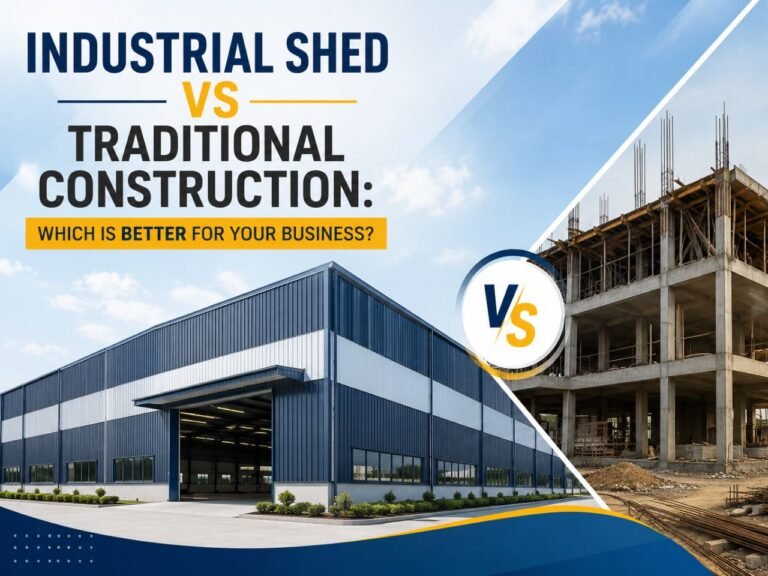
Industrial Shed vs Traditional Construction: Which is Better for Your Business?
Introduction
Imagine you’re planning a new manufacturing plant or warehouse in India. You have purchased the land, secured financing, and finalized your business expansion strategy. Now comes one of the most important decisions that will affect your investment for decades—should you build a modern industrial shed or choose traditional construction?
Many business owners still believe conventional RCC buildings are the safest choice. However, today’s industries are rapidly shifting toward Pre-Engineered Building (PEB) industrial sheds because they offer faster construction, lower costs, greater flexibility, and long-term savings.
Whether you’re building a warehouse in Delhi NCR, a manufacturing unit in Gujarat, a logistics center in Maharashtra, or a factory in Tamil Nadu, selecting the right construction method directly impacts your operational efficiency and return on investment.
In this guide, we’ll compare industrial sheds and traditional construction in detail so you can make an informed decision for your business.
What Is an Industrial Shed?
An industrial shed is a steel-based structure, usually built using Pre-Engineered Building (PEB) technology, designed for manufacturing, warehousing, logistics, factories, workshops, and industrial operations.
Detailed Explanation
Unlike conventional concrete buildings, industrial sheds are manufactured using precision-engineered steel components that are fabricated in factories and assembled at the project site.
Modern industrial sheds typically include:
- Primary steel structure
- Secondary framing
- Roofing system
- Wall cladding
- Insulation
- Skylights
- Ventilation systems
- Mezzanine floors
- Crane systems
Because most components are manufactured before reaching the site, project execution becomes significantly faster and more efficient.
What Is Traditional Construction?
Traditional construction refers to buildings constructed using reinforced cement concrete (RCC), brick walls, and extensive on-site labor.
Detailed Explanation
Traditional buildings have been used for decades across residential and commercial projects.
The construction process generally includes:
- Excavation
- Foundation work
- RCC columns
- Brick masonry
- Concrete slabs
- Plastering
- Finishing work
Although durable, traditional construction often requires longer timelines, higher labor costs, and greater material consumption compared to PEB structures.
Industrial Shed vs Traditional Construction: Quick Comparison
| Feature | Industrial Shed (PEB) | Traditional Construction |
|---|---|---|
| Construction Speed | Very Fast | Slow |
| Initial Cost | Lower | Higher |
| Maintenance | Low | Moderate to High |
| Future Expansion | Easy | Difficult |
| Construction Waste | Minimal | High |
| Structural Weight | Lightweight | Heavy |
| Earthquake Performance | Excellent | Moderate |
| Large Column-Free Space | Yes | Limited |
| Sustainability | High | Moderate |
Which Option Saves More Money?
Industrial sheds generally offer better long-term value because they reduce construction costs, labor expenses, maintenance, and future expansion costs.
Cost Comparison
Building costs include much more than materials.
Businesses should evaluate:
- Foundation cost
- Structural material
- Labor
- Construction timeline
- Maintenance
- Operational expenses
Since steel structures are lighter than RCC buildings, foundations are often smaller, reducing excavation and concrete requirements.
Factory fabrication also minimizes material wastage.
Cost Breakdown
| Expense | Industrial Shed | Traditional Building |
|---|---|---|
| Foundation | Lower | Higher |
| Steel/Concrete | Optimized | Higher Consumption |
| Labor | Less | More |
| Construction Time | 4–8 Months | 8–18 Months |
| Maintenance | Low | Higher |
| Future Expansion | Affordable | Expensive |
Which Construction Method Is Faster?
Industrial sheds are significantly faster because structural components are manufactured before reaching the construction site.
Why Speed Matters
Every month a factory remains under construction means delayed production, delayed revenue, and increased financing costs.
With industrial sheds:
- Engineering begins immediately.
- Components are manufactured simultaneously.
- Site preparation continues while fabrication is underway.
- Installation is completed quickly.
This parallel workflow reduces project duration by 30–50% compared to traditional construction.
Which Structure Offers More Usable Space?
Industrial sheds provide larger column-free spaces, making them ideal for warehouses, manufacturing plants, and logistics facilities.
Why Clear Span Matters
Large open spaces improve:
- Inventory storage
- Machine placement
- Forklift movement
- Loading operations
- Future layout changes
Traditional RCC buildings often require multiple internal columns, reducing usable floor space.
For warehouses and factories, every square foot matters.
Durability: Which Building Lasts Longer?
Both construction methods are durable when built correctly, but modern galvanized steel PEB structures provide excellent corrosion resistance and require less maintenance.
Industrial Shed Advantages
- High-strength structural steel
- Corrosion-resistant coatings
- Precision fabrication
- Better load distribution
- Easy replacement of damaged components
Modern industrial sheds are designed to withstand:
- Heavy wind loads
- Earthquakes
- Rainfall
- Snow (where applicable)
- Industrial operating conditions
Which Option Is Better for Future Expansion?
Industrial sheds are designed for modular expansion, making them the preferred choice for growing businesses.
Example
Suppose your warehouse currently requires 40,000 sq. ft.
After three years, demand increases.
With a PEB structure, engineers can simply add:
- Additional bays
- Warehouse extensions
- Office space
- Mezzanine floors
- Crane systems
Traditional construction often requires extensive demolition and rebuilding.
Sustainability and Environmental Benefits
Today’s businesses are focusing on green construction.
Industrial sheds support sustainability through:
- Recyclable steel
- Lower carbon footprint
- Reduced construction waste
- Energy-efficient roofing
- Natural lighting systems
- Rainwater harvesting compatibility
Many companies pursuing green certifications prefer steel-based industrial buildings because of their environmental advantages.
Which Industries Benefit Most from Industrial Sheds?
Industrial sheds are ideal for:
- Manufacturing Plants
- Warehouses
- Logistics Centers
- Cold Storage Facilities
- Food Processing Units
- Automobile Industries
- Textile Industries
- Pharmaceutical Companies
- Engineering Workshops
- E-commerce Fulfillment Centers
- Agricultural Storage Facilities
Across India, businesses in Delhi NCR, Haryana, Gujarat, Maharashtra, Rajasthan, Karnataka, Tamil Nadu, Uttar Pradesh, and Telangana are increasingly adopting PEB industrial sheds due to their speed, efficiency, and long-term cost savings.
Expert Insight
Construction decisions should not be based solely on the initial project cost.
Instead, businesses should evaluate the total lifecycle cost, including:
- Construction time
- Maintenance
- Operational efficiency
- Energy consumption
- Expansion capability
- Return on investment
In many cases, industrial sheds deliver significantly better value over the building’s lifetime.