

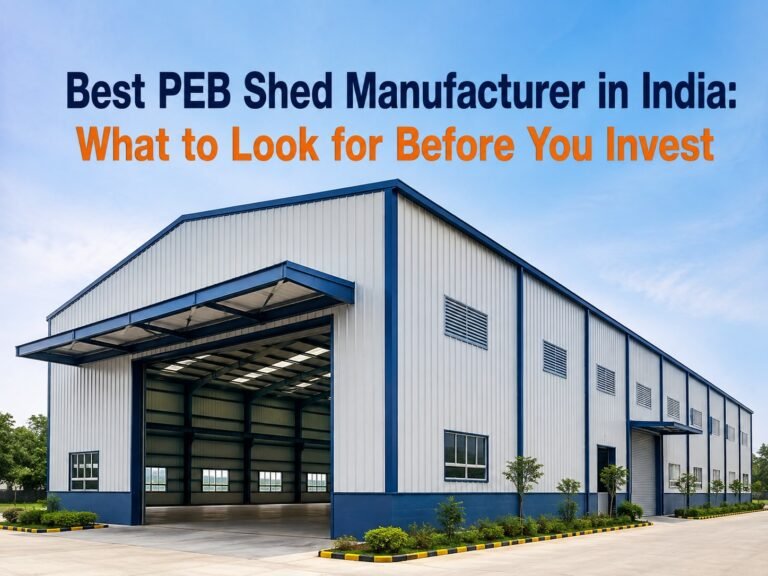
Best PEB Shed Manufacturer in India: What to Look for Before You Invest
Choosing a PEB shed manufacturer in India is not simply about comparing steel prices or selecting the company offering the lowest quotation. A PEB project is a long-term investment in your factory, warehouse, logistics facility, production unit, or commercial infrastructure. The manufacturer you select can influence structural quality, construction speed, project coordination, maintenance requirements, expansion possibilities, and the overall performance of your building.
India’s growing manufacturing and infrastructure activity is also increasing the importance of efficient steel construction. According to the Ministry of Steel’s 2025–26 Annual Report, India consumed 152.13 million tonnes of steel in FY2025, while total steel demand is projected to reach approximately 230 million tonnes by FY2031. Building, construction, and infrastructure are among the major drivers of this demand.
So, how do you identify the best PEB shed manufacturer in India for your project?
The answer starts with looking beyond the quotation.
A reliable PEB partner should combine engineering expertise, manufacturing capability, quality control, project execution, customization, transparent communication, and dependable after-sales support.
This guide explains the key factors to evaluate before investing.
What Is a PEB Shed?
Quick Answer:
A Pre-Engineered Building (PEB) shed is a steel building system designed and engineered according to project requirements, manufactured as components, transported to the project site, and assembled there. PEB systems are widely used for warehouses, factories, manufacturing plants, logistics facilities, workshops, and other industrial applications.
Unlike conventional construction, much of the structural fabrication takes place in a controlled manufacturing environment before components reach the site. This approach can simplify site erection and improve coordination between design, manufacturing, transportation, and installation.
A PEB shed may include:
- Primary steel frames
- Secondary structural members
- Roofing systems
- Wall cladding
- Bracing systems
- Doors and shutters
- Insulation
- Ventilation systems
- Skylights
- Mezzanine floors
- Crane-supporting arrangements
- Drainage and rainwater systems
The final specification depends on the building’s purpose, dimensions, loads, location, architectural requirements, and operational needs.
Practical Tip: Do not evaluate a PEB quotation only on the basis of steel tonnage. Review the complete technical specification and scope of work.
Why Choosing the Right PEB Shed Manufacturer Matters
Quick Answer:
The right PEB manufacturer helps ensure that your building is properly engineered, accurately fabricated, safely erected, and delivered according to the project’s requirements. A manufacturer’s capabilities can directly affect construction quality, project coordination, timeline, future expansion, and long-term operating value.
A PEB building involves multiple connected stages:
Requirement → Design → Engineering → Fabrication → Quality Control → Transportation → Erection → Handover
A weakness at any stage can create problems later.
For example, poor structural detailing can cause fabrication issues. Inaccurate fabrication can create erection difficulties. Poor project coordination can delay installation. Inadequate quality control can affect long-term durability.
This is why the best PEB shed manufacturer in India should be evaluated as an engineering and project-delivery partner, not simply as a steel supplier.
Practical Tip: Ask the manufacturer who will be responsible for engineering, fabrication, erection, quality inspection, and project management before signing the contract.
1. Check the Manufacturer’s Engineering Expertise
Engineering capability should be one of the first factors you evaluate. A professional PEB manufacturer should be able to develop structural designs based on building dimensions, loads, location, operational requirements, and applicable standards rather than simply supplying a standard shed design.
PEB structures are engineered around specific project conditions.
Important considerations can include:
- Building width and length
- Clear span requirements
- Eave and ridge height
- Roof slope
- Wind loads
- Seismic requirements
- Roof loads
- Equipment loads
- Crane loads
- Mezzanine requirements
- Future expansion
- Site conditions
In India, structural steel design is covered by IS 800:2007, General Construction in Steel — Code of Practice, as identified by the Bureau of Indian Standards.
For industrial structures, seismic design requirements also need appropriate consideration. BIS has a dedicated IS 1893 Part 4 covering earthquake-resistant design of industrial and stack-like structures.
Practical Tip: Ask for the design basis, structural calculations where appropriate, applicable standards, drawings, and approval process.
2. Evaluate the Manufacturing Facility
Quick Answer:
A manufacturer’s production capability matters because controlled fabrication can improve consistency, dimensional accuracy, production planning, and quality inspection. Look for an established manufacturing facility with appropriate machinery, trained personnel, material handling systems, and documented quality processes.
A capable PEB manufacturer may use equipment such as:
- CNC plasma cutting machines
- Roll-forming machines
- MIG and ARC welding systems
- Radial drilling machines
- Power presses
- Bending equipment
- Automated or semi-automated fabrication systems
Jai Bharat PEB states that it operates a 2,50,000+ sq. ft. manufacturing facility equipped with fabrication machinery and a skilled workforce. Its facility information also lists CNC plasma cutting, trapezoidal roll forming, MIG and ARC welding, and radial drilling equipment.
The important point is not simply facility size. It is whether the facility supports consistent quality, production capacity, inspection, and project scheduling.
Practical Tip: If possible, visit the manufacturing facility before awarding a major project.
3. Look for End-to-End PEB Services
Quick Answer:
An end-to-end PEB partner can reduce coordination gaps by managing multiple project stages under one system. Ideally, the scope should clearly explain responsibilities for design, engineering, fabrication, transportation, erection, civil works, and other associated services.
A complete PEB project may involve:
- Site and requirement assessment
- Architectural planning
- Structural engineering
- 3D modelling and detailing
- Shop drawings
- Steel fabrication
- Quality inspection
- Transportation
- Site erection
- Roofing and cladding
- Civil and flooring work
- Final inspection
- Handover
Jai Bharat PEB describes its services as covering design, engineering, manufacturing, fabrication, installation, and turnkey project execution.
This integrated approach can be particularly useful for businesses that do not want to coordinate several independent contractors.
Practical Tip: Request a written scope matrix showing exactly what is included and excluded from the quotation.
4. Compare Quality, Not Just Price
Quick Answer:
The cheapest PEB quotation is not necessarily the most economical project. A meaningful comparison should consider steel specifications, structural design, coating systems, roofing, cladding, fabrication quality, transportation, erection, warranty, and included civil or auxiliary works.
Two manufacturers may quote different prices because their technical specifications are different.
Before comparing quotations, check:
| Factor | What to Compare |
|---|---|
| Steel | Grade and specifications |
| Structural design | Design basis and applicable standards |
| Fabrication | Cutting, welding and dimensional accuracy |
| Roofing | Sheet specification and coating |
| Cladding | Thickness, coating and profile |
| Paint/coating | Surface preparation and system |
| Fasteners | Type and quality |
| Insulation | Material and thickness |
| Erection | Scope and manpower |
| Civil work | Included or excluded |
| Transportation | Included or extra |
| Warranty | Coverage and duration |
| Future expansion | Design provision |
A lower initial price may become expensive if important components are excluded.
Practical Tip: Create a technical comparison sheet and compare quotations line by line before making a decision.
5. Ask About Quality Control
Quick Answer:
Quality control should cover the complete project lifecycle—from incoming raw materials to fabrication, inspection, dispatch, erection, and final handover. A professional manufacturer should have defined inspection procedures rather than relying only on visual checks at the end.
Quality assurance may involve:
- Raw material inspection
- Material certificates
- Dimensional inspection
- Welding inspection
- Bolt and connection checks
- Surface preparation
- Coating inspection
- Component identification
- Packing and dispatch inspection
- Erection inspection
Jai Bharat PEB states that its quality processes include raw-material inspection, fabrication and welding checks, dimensional verification, surface treatment, multi-stage inspection, and on-site supervision. It also identifies ISO 9001:2015 certification for its manufacturing facility.
Practical Tip: Ask what inspection records and material documentation will be provided with your project.
6. Consider Customization and Future Expansion
Quick Answer:
A good PEB system should be designed around your operational requirements rather than forcing your business into a fixed building format. Customization can include span, height, openings, cranes, mezzanines, ventilation, insulation, loading requirements, and provisions for future expansion.
For a growing manufacturing or logistics business, today’s building may not be the final building requirement.
You may later need:
- Additional production space
- More storage capacity
- Crane installation
- Additional loading bays
- Mezzanine floors
- New machinery
- Office areas
- Additional doors
- Extended building length
Jai Bharat PEB states that its structures can be customized according to dimensions, load requirements, operational layouts, and future expansion plans.
Example: A warehouse designed with future expansion in mind can potentially make later extensions easier to plan than a structure designed only for today’s capacity.
Practical Tip: Tell your PEB manufacturer about your expected business growth before the engineering stage begins.
7. Check Project Experience and Previous Work
Quick Answer:
Past project experience provides useful evidence of a manufacturer’s ability to manage real construction requirements. Instead of relying only on marketing claims, review completed projects that are similar in size, application, location, complexity, or structural requirements to your proposed building.
Look for experience in:
- Manufacturing plants
- Warehouses
- Logistics hubs
- Cold storage
- Automotive facilities
- FMCG infrastructure
- Engineering units
- Industrial workshops
- Commercial buildings
Jai Bharat PEB showcases projects including PEB warehouses and industrial facilities and states that it serves multiple industrial and commercial locations across India.
Practical Tip: Ask for project photographs, technical scope, completion information, and client references where available.
8. Evaluate the Manufacturer’s Civil Construction Capability
PEB and civil construction are closely connected because the steel building ultimately depends on properly planned foundations, flooring, drainage, site development, and related infrastructure. An integrated PEB and civil construction partner can help coordinate these interfaces more effectively.
Civil construction requirements may include:
- Site development
- Foundation work
- RCC works
- Anchor bolt installation
- Industrial flooring
- Drainage
- Roads and access areas
- Utility infrastructure
- Boundary works
Jai Bharat PEB lists civil construction alongside PEB solutions, industrial construction, steel fabrication, and turnkey services.
For larger industrial projects, coordination between civil and structural teams is particularly important.
Practical Tip: Clarify the foundation design responsibility, anchor-bolt coordination, flooring specification, and civil scope before construction begins.
9. Check Delivery and Installation Capability
Quick Answer:
A PEB structure is only valuable when the fabricated components reach the site correctly and are erected safely. The manufacturer’s transportation planning, site coordination, erection team, equipment, sequencing, and project management capability can therefore have a major effect on the construction schedule.
A typical sequence may look like:
Fabrication → Quality Inspection → Packing → Transportation → Site Receipt → Component Identification → Erection → Roofing & Cladding → Final Inspection
Jai Bharat PEB describes its fabrication and installation service as an integrated process covering fabrication, delivery, erection, and project support.
Project timelines vary based on building size, complexity, site readiness, design approvals, weather, transportation, and scope. Therefore, avoid accepting unrealistic delivery promises without a detailed schedule.
Practical Tip: Ask for a project schedule showing engineering, fabrication, dispatch, erection, and handover milestones.
10. Review Geographic Reach and Local Execution
For a PEB project in India, geographic execution capability matters because transportation, site access, local labour, weather, approvals, and project coordination can differ by region. Choose a manufacturer that has experience executing projects in your state or industrial corridor.
Jai Bharat PEB identifies project and manufacturing coverage across locations including Delhi NCR, Gurgaon, Noida, Ahmedabad, Hyderabad, Pune, Chennai, Bangalore, Jaipur, Neemrana, Bhiwadi, and the Yamuna Expressway, among others.
For a project in Haryana, for example, proximity to a manufacturing facility can potentially simplify logistics and site coordination. For projects farther away, transportation planning becomes increasingly important.
Practical Tip: Ask how transportation, erection teams, project supervision, and after-sales support will be managed at your location.
11. Understand the Total Cost of a PEB Project
Quick Answer:
The total cost of a PEB project depends on more than the structural steel frame. Building dimensions, steel quantity, roofing, cladding, insulation, foundation, flooring, doors, ventilation, electrical work, fire systems, transportation, erection, and site conditions can all affect the final investment.
A useful budgeting approach is to divide costs into categories:
Structural Package
- Primary frames
- Secondary members
- Bracing
- Connections
Building Envelope
- Roofing
- Wall cladding
- Insulation
- Flashings
- Gutters
Civil Works
- Foundations
- Flooring
- Drainage
- Site development
Project Execution
- Transportation
- Erection
- Equipment
- Labour
- Site supervision
Additional Requirements
- Cranes
- Mezzanine
- Ventilation
- Skylights
- Doors
- Electrical systems
- Fire protection
This creates a more realistic picture of the investment than comparing only the quoted price per square foot.
Practical Tip: Ask for a detailed commercial breakup and clearly identify taxes, transportation, civil works, and optional items.
PEB vs Conventional Construction: Which Is Better?
Neither construction method is automatically better for every project. PEB is often attractive for industrial buildings where speed, large spans, steel efficiency, customization, and future expansion are priorities. Conventional construction may be appropriate for projects where concrete construction, architectural requirements, or specific structural conditions make it more suitable.
| Feature | PEB | Conventional Construction |
|---|---|---|
| Construction approach | Engineered steel system | Site-based conventional construction |
| Fabrication | Controlled manufacturing | More site-dependent |
| Construction speed | Generally faster for suitable projects | Often more site-intensive |
| Large clear spans | Highly suitable | Can require more structural material |
| Expansion | Can be planned into design | May require more extensive modification |
| Customization | High | High |
| Industrial use | Excellent fit | Also possible |
| Initial comparison | Depends on specification | Depends on specification |
| Quality control | Factory + site | More site-dependent |
| Best application | Industrial, warehouse, logistics | Broad range of building types |
The right choice depends on project requirements, structural design, site conditions, budget, and intended use.
Practical Tip: Ask an experienced engineer to compare both systems for your specific building instead of assuming one method is universally superior.
Why Businesses Choose Jai Bharat PEB
Quick Answer:
Jai Bharat PEB positions itself as an integrated PEB and industrial construction partner, combining engineering, fabrication, installation, civil construction, and turnkey execution. Its website states 25+ years of experience, a 2,50,000+ sq. ft. manufacturing facility, 350+ successfully delivered projects, 100+ ongoing projects, and a pan-India service network. s
The company offers:
- PEB shed manufacturing
- Industrial buildings
- Warehouse construction
- Steel fabrication
- Civil construction
- Turnkey project execution
- Crane structures
- Cold storage structures
- Commercial buildings
- Logistics infrastructure
Its manufacturing and service information also highlights customized design, engineering, fabrication, quality assurance, installation, and project management.
For businesses searching for a PEB Shed Manufacturer in India, the key advantage of an integrated partner is coordination across multiple stages.
The objective should not simply be to buy a steel building.
It should be to develop infrastructure that supports your business for years.
Practical Tip: Before selecting Jai Bharat PEB—or any manufacturer—verify the current project scope, specifications, certifications, commercial terms, and delivery commitments for your individual project.
What Questions Should You Ask Before Selecting a PEB Manufacturer?
Quick Answer:
Before signing a PEB contract, ask questions about engineering, materials, manufacturing capacity, quality control, project experience, installation, timelines, warranty, civil work, payment terms, and future expansion. Clear answers at the beginning can prevent misunderstandings during construction.
Use this checklist:
Engineering
- Who is responsible for structural design?
- Which standards will be followed?
- Will structural drawings be provided?
- How are wind and seismic requirements considered?
Manufacturing
- Where will the building be fabricated?
- What machinery is available?
- How is dimensional accuracy controlled?
- What quality inspections are performed?
Materials
- What steel specifications will be used?
- What roofing and cladding specifications are included?
- What coating system is proposed?
- Are material certificates available?
Project Execution
- Who manages transportation?
- Who handles erection?
- What equipment is required?
- What is the project schedule?
Commercial
- What is included in the quoted price?
- Are foundations included?
- Is flooring included?
- Is transportation included?
- What taxes and additional costs apply?
Long-Term
- What warranty is provided?
- What after-sales support is available?
- Can the building be expanded later?
- What maintenance is recommended?
Common Mistakes to Avoid When Choosing a PEB Shed Manufacturer
Quick Answer:
The most common mistakes include selecting a manufacturer only on the lowest price, ignoring technical specifications, failing to check previous projects, overlooking civil work interfaces, accepting vague timelines, and not defining exclusions in the contract.
Avoid these mistakes:
1. Choosing the Cheapest Quotation
A low price can sometimes reflect differences in material specifications or project scope.
2. Ignoring Engineering
A building should be designed for actual site and operational requirements.
3. Not Comparing Technical Specifications
Compare steel, roofing, cladding, coating, fasteners, insulation, and accessories.
4. Forgetting Future Expansion
Business requirements can change. Consider expansion during initial planning.
5. Not Checking Site Readiness
Foundation, anchor bolts, access, drainage, and site levels can affect erection.
6. Accepting Verbal Commitments
Important commercial and technical commitments should be documented.
7. Not Defining the Scope
Clearly identify what is included and excluded.
8. Ignoring Maintenance
Discuss corrosion protection, roofing maintenance, drainage, and inspection requirements.
PEB Shed Manufacturer in India: Final Selection Checklist
Before making your final decision, score each shortlisted manufacturer against these factors:
| Selection Factor | Priority |
|---|---|
| Engineering expertise | Very High |
| Manufacturing capability | Very High |
| Quality control | Very High |
| Project experience | High |
| Material specifications | Very High |
| Customization | High |
| Installation capability | Very High |
| Civil construction coordination | High |
| Delivery planning | High |
| Warranty & support | High |
| Transparent quotation | Very High |
| Future expansion | High |
| Geographic execution | High |
The best PEB shed manufacturer in India for your project is not necessarily the company with the biggest advertisement or lowest quotation. It is the partner that can demonstrate the right combination of engineering capability, manufacturing quality, execution experience, transparent scope, project coordination, and long-term support.
Frequently Asked Questions About the Best PEB Shed Manufacturer in India
1. How do I choose the best PEB shed manufacturer in India?
Choose a manufacturer based on engineering expertise, manufacturing capacity, quality control, previous projects, material specifications, installation capability, project management, pricing transparency, and after-sales support. Compare complete technical and commercial proposals rather than selecting a company only because it offers the lowest price.
2. What does a PEB shed manufacturer do?
A PEB shed manufacturer typically designs, engineers, fabricates, and supplies steel building components. Depending on the company’s scope, it may also provide transportation, erection, roofing, cladding, civil construction, project management, and turnkey execution.
3. Is PEB suitable for manufacturing plants?
Yes. PEB systems are widely suited to manufacturing facilities because they can accommodate large spans, industrial layouts, equipment requirements, ventilation, cranes, loading areas, and future expansion. The final structural design should be based on the specific operational and site requirements.
4. How much does a PEB shed cost in India?
There is no single standard PEB shed price because project cost depends on size, location, structural design, steel quantity, roofing, cladding, insulation, foundation, flooring, accessories, transportation, erection, and other requirements. A manufacturer should provide a project-specific quotation.
5. Is PEB construction faster than conventional construction?
PEB can provide faster project execution for suitable industrial and commercial buildings because structural components are fabricated in a controlled manufacturing environment and then assembled at the site. Actual project duration depends on design approvals, site readiness, fabrication, logistics, weather, and construction scope.
6. Can a PEB shed be customized?
Yes. PEB buildings can be customized for dimensions, clear spans, heights, doors, ventilation, insulation, cranes, mezzanines, roofing, cladding, and other operational requirements. Future expansion can also be considered during the engineering stage.
7. Which cities does Jai Bharat PEB serve?
Jai Bharat PEB states that it serves projects across India, including major industrial locations such as Gurgaon, Noida, Ahmedabad, Hyderabad, Pune, Chennai, Bangalore, Jaipur, Neemrana, Bhiwadi, and other industrial corridors.
8. Does Jai Bharat PEB provide civil construction?
Yes. Jai Bharat PEB lists civil construction among its services, including RCC structures, industrial foundations, infrastructure development, and concrete structures.
9. What should I compare between two PEB manufacturers?
Compare engineering design, steel specifications, structural weight, roofing and cladding, coating system, accessories, quality control, manufacturing capability, transportation, erection, civil work, warranty, delivery schedule, and exclusions. Comparing only the price per square foot can produce a misleading result.
10. Why should I choose an experienced PEB manufacturer?
Experience can help a manufacturer understand common engineering, fabrication, logistics, and erection challenges. However, experience should be evaluated alongside current manufacturing capability, qualified professionals, quality systems, project references, technical documentation, and the specific requirements of your project.
Final Takeaway
Selecting a PEB shed manufacturer in India is ultimately a decision about more than steel.
It is a decision about engineering, reliability, execution, cost control, safety, scalability, and long-term business performance.
Before you invest, compare manufacturers on the factors that matter most: technical expertise, manufacturing infrastructure, quality systems, project experience, customization, civil coordination, installation capability, transparent pricing, and after-sales support.
Jai Bharat PEB presents itself as a pan-India PEB and construction partner with engineering, manufacturing, fabrication, civil construction, and turnkey capabilities.
For a major industrial investment, the smartest approach is simple:
Don’t choose a PEB manufacturer only by the price of the building. Choose the partner behind the building.
A well-engineered PEB is not just a faster way to construct an industrial space—it can become the foundation for your company’s next stage of growth.