

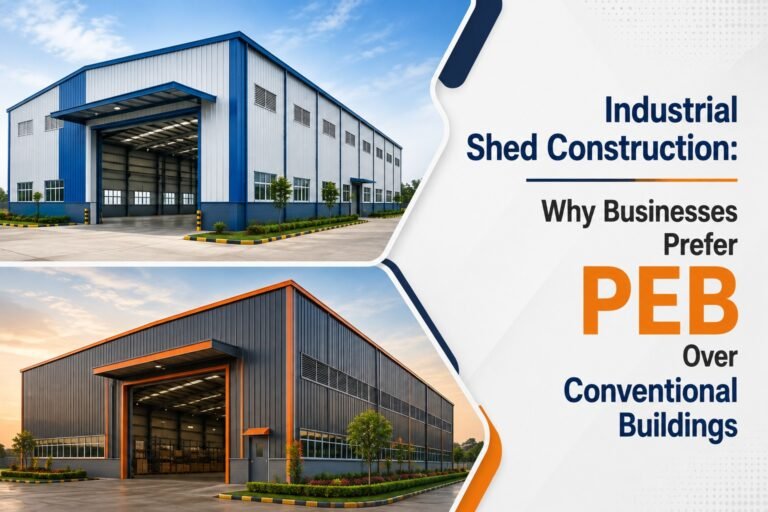
Industrial Shed Construction: Why Businesses Prefer PEB Over Conventional Buildings
Industrial construction is changing rapidly. Businesses today need facilities that can be planned efficiently, constructed faster, adapted to future growth, and delivered with predictable quality. This is where Pre-Engineered Buildings (PEB) have become an increasingly practical option for warehouses, factories, manufacturing units, logistics centres, and other industrial facilities.
A PEB uses steel components that are engineered and fabricated before being transported to the project site for assembly. Unlike conventional construction, where much of the structural work happens on-site, PEB construction shifts a significant part of the process to controlled manufacturing environments.
For businesses evaluating industrial shed construction, the real question is not simply “PEB or conventional?” It is which system better matches the project’s size, use, timeline, budget, site conditions, and future expansion plans.
What Is Industrial Shed Construction?
Industrial shed construction is the development of large functional structures used for manufacturing, storage, processing, logistics, workshops, and other industrial activities. These buildings typically require large floor areas, efficient circulation, durable structures, and provisions for equipment and utilities.
PEB systems are particularly suitable where businesses need large-span spaces and relatively rapid project execution. Jai Bharat PEB provides industrial building solutions covering design, engineering, manufacturing, delivery, erection, inspection, and after-sales support.
Why Are Businesses Choosing PEB?
Quick answer: Businesses often choose PEB because factory-fabricated components can simplify site assembly, improve production control, and support faster project execution compared with many conventional construction approaches.
The exact advantage depends on design complexity, foundation readiness, site conditions, approvals, and project scope. PEB should therefore be evaluated as a complete system rather than simply as a cheaper alternative.
PEB vs Conventional Industrial Buildings
| Feature | PEB Construction | Conventional Construction |
|---|---|---|
| Structural fabrication | Factory-based | Primarily site-based |
| Construction process | Engineered assembly | Multiple site activities |
| Design flexibility | Highly customizable | Customizable |
| Large clear spans | Well suited | Possible with appropriate design |
| Site dependency | Lower for fabrication | Higher |
| Future expansion | Can be planned into design | May require more structural work |
| Project coordination | Integrated | Often involves multiple trades |
The National Building Code of India provides provisions covering structural design, construction safety, steel construction, prefabrication, and construction management. Steel structures must also be designed for applicable loads and site conditions using relevant standards.
Faster Construction
Question: Does PEB reduce industrial construction time?
Answer: PEB can reduce on-site construction time because structural components are fabricated while foundation and other site activities can progress. This parallel workflow can shorten the overall project schedule when planning and site readiness are properly managed.
Jai Bharat PEB currently describes typical industrial building projects as dependent on size and complexity, with project timelines varying accordingly.
Practical tip: Complete soil investigation, foundation design, drawings, approvals, and site preparation early to avoid delaying erection.
Cost Efficiency
PEB can provide cost advantages through optimized structural design, controlled fabrication, reduced site labour requirements, and potentially shorter project schedules. However, there is no universal “per-square-foot” saving because costs depend on span, height, crane requirements, foundation conditions, roofing, cladding, insulation, location, and specifications.
India’s Steel Ministry has also highlighted the cost-effectiveness, shorter erection lead times, and durability advantages associated with steel structures.
Practical tip: Compare the complete project cost—not only the initial steel price.
Better Quality Control
Factory manufacturing provides a controlled environment for cutting, welding, drilling, and component inspection. Jai Bharat PEB states that its manufacturing process includes material inspection, fabrication checks, dimensional verification, welding quality checks, and final inspection before dispatch.
This can improve consistency, provided engineering specifications and quality procedures are properly followed.
Design Flexibility
Modern industrial buildings rarely have identical requirements. A food-processing unit may need insulation and hygiene considerations, while a logistics facility may prioritize loading bays, clear height, and vehicle movement.
PEB structures can be engineered around specific dimensions, loads, openings, equipment, and future expansion requirements.
Large-Span Industrial Spaces
Manufacturing and warehousing operations often benefit from open internal areas. PEB systems can be designed for large clear-span spaces, reducing unnecessary internal structural obstructions where engineering requirements permit.
This can improve material movement, equipment placement, storage planning, and production layouts.
Durability and Structural Performance
A PEB is not automatically stronger than every conventional building. Structural performance depends on engineering, materials, connections, foundations, loads, workmanship, and maintenance.
For Indian projects, applicable standards and local requirements should be considered. BIS identifies IS 800 for general construction in steel, while loads such as wind and other actions are addressed through relevant Indian Standards.
Future Expansion
Question: Can a PEB industrial shed be expanded later?
Answer: Yes, expansion can often be incorporated into the original planning and structural design. Future bays, additional floor space, openings, or operational changes can be considered during the initial engineering stage.
Planning expansion from day one is generally more efficient than modifying an already completed structure without preparation.
PEB for Manufacturing and Warehousing
PEB solutions are widely applicable to manufacturing plants, warehouses, distribution centres, cold-storage facilities, workshops, logistics hubs, and processing units. Jai Bharat PEB specifically lists these applications within its industrial building portfolio.
For India’s expanding industrial and manufacturing ecosystem, efficient infrastructure can play an important role in business expansion. The National Steel Policy also emphasizes technology, infrastructure, logistics, and energy efficiency within India’s steel sector.
Why Choose Jai Bharat PEB?
Question: What should businesses look for in a PEB manufacturer?
Answer: Look for engineering capability, manufacturing infrastructure, quality controls, project execution experience, transparent specifications, installation expertise, and reliable post-project support.
Jai Bharat PEB identifies itself as a PEB manufacturer and industrial construction provider based in Sonipat, Haryana, with a reported 2,50,000 sq. ft. manufacturing facility and integrated fabrication capabilities.
Its services cover PEB sheds, industrial buildings, steel fabrication, civil construction, and turnkey execution.
Final Takeaway
For many industrial projects, PEB offers a practical combination of speed, engineering efficiency, flexibility, and controlled fabrication. Conventional construction still has an important role, particularly where project requirements demand specific structural or architectural approaches.
The right decision should be based on engineering requirements, lifecycle cost, site conditions, functionality, expansion plans, and the capability of the construction partner.
For businesses planning industrial shed construction in India, choosing the right PEB manufacturer can be just as important as choosing the building system itself.
Build smarter. Build faster. Build for long-term industrial growth with Jai Bharat PEB.
Industrial Shed Construction FAQs
1. What is an industrial PEB shed?
A steel building whose major structural components are engineered and fabricated before being assembled at the project site.
2. Is PEB better than conventional construction?
It can be more efficient for many industrial applications, particularly where speed, large spans, and future flexibility are important.
3. How much does industrial shed construction cost?
There is no fixed price. Cost depends on size, design, steel specifications, foundation, roofing, insulation, location, and project requirements.
4. Can PEB sheds be customized?
Yes. Dimensions, layouts, openings, roofing, cladding, insulation, crane provisions, and other requirements can be engineered according to the project.
5. Does Jai Bharat PEB provide services across India?
Jai Bharat PEB states that it provides PEB industrial building solutions across India.