


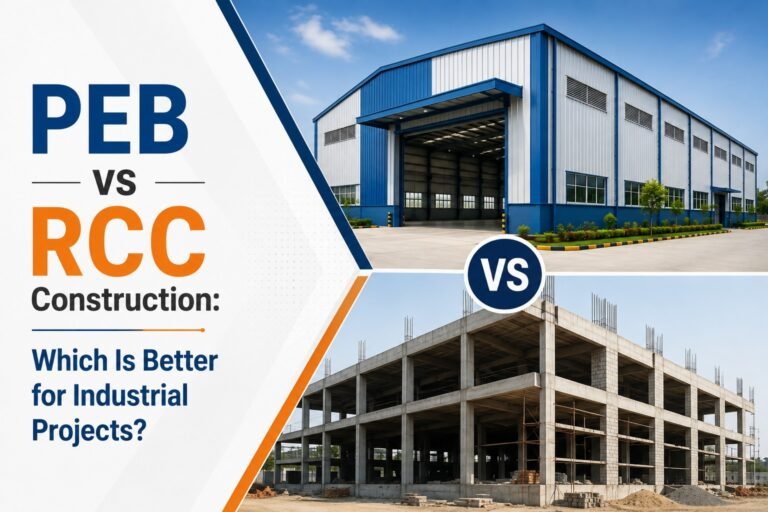
PEB vs RCC Construction: Which Is Better for Industrial Projects?
Industrial construction is no longer only about putting up a strong building. For manufacturers, warehouse operators, logistics companies, and industrial developers, the building must also be fast to construct, cost-efficient, adaptable, durable, and ready for future expansion.
This is where the choice between PEB vs RCC construction becomes important. Pre-Engineered Buildings (PEB) use engineered steel components that are fabricated and assembled for a specific project, while RCC construction uses reinforced concrete as the primary structural system.
So, which is better for industrial projects? The answer depends on the building’s purpose, span, loads, site conditions, budget, timeline, and future expansion plans.
What Is PEB Construction?
Quick Answer: PEB construction is a steel building system in which structural components are engineered, fabricated, and prepared before being assembled at the project site. It is widely suited to warehouses, factories, manufacturing facilities, logistics buildings, and industrial sheds.
PEB systems can provide large usable spaces, customized dimensions, faster erection, and efficient structural design. Jai Bharat PEB provides PEB, industrial construction, warehouse, and turnkey infrastructure solutions across India.
What Is RCC Construction?
Quick Answer: RCC construction uses reinforced cement concrete, combining concrete and steel reinforcement to create structural elements such as columns, beams, slabs, and foundations.
RCC remains a well-established construction method and is appropriate for many building types. In India, IS 456:2000 is the BIS code of practice for plain and reinforced concrete. (Bureau of Indian Standards)
For industrial projects, however, RCC may involve more extensive on-site formwork, reinforcement, concrete placement, and curing compared with a steel PEB system.
PEB vs RCC: Key Differences
| Feature | PEB Construction | RCC Construction |
|---|---|---|
| Primary structure | Structural steel | Reinforced concrete |
| Construction method | Factory fabrication + site assembly | Predominantly site-based construction |
| Construction speed | Generally faster | Generally slower |
| Large clear spans | Excellent for many industrial applications | Can require substantial structural design |
| Future expansion | Highly adaptable when planned properly | Possible, but may require more structural intervention |
| Site labour | Lower on-site structural fabrication | Higher site activity |
| Industrial suitability | Warehouses, factories, logistics, sheds | Multi-storey and heavy concrete applications |
| Design flexibility | High for industrial layouts | High, depending on structural system |
| Maintenance | Depends on coatings and detailing | Depends on concrete quality and exposure |
Which Is Faster: PEB or RCC?
Quick Answer: PEB construction is generally faster because major steel components are fabricated under controlled manufacturing conditions while site preparation and foundation work can progress simultaneously.
This parallel workflow can reduce the amount of structural work required at the site. Jai Bharat PEB describes its integrated manufacturing approach as supporting faster project execution through coordination between engineering, fabrication, quality control, and installation.
Practical Tip: If your business needs production or warehouse space quickly, compare the complete project schedule rather than only comparing structural material costs.
Which Is More Cost-Effective?
Quick Answer: PEB can offer strong cost efficiency for many industrial buildings because optimized steel design, prefabrication, faster erection, and reduced site activity can improve overall project economics.
However, there is no universal percentage saving. The final cost depends on span, height, loading, foundation requirements, location, soil conditions, crane requirements, roofing and cladding, MEP services, and civil works.
For a fair PEB vs RCC construction cost comparison, compare the complete installed project—not just steel or concrete rates.
Which Provides Better Clear-Span Space?
Quick Answer: PEB is often an excellent choice when an industrial facility requires wide, open and column-efficient floor areas.
This is particularly valuable for manufacturing plants, warehouses, logistics hubs, and storage facilities, where uninterrupted movement of machinery, forklifts, racks, and materials can improve operational efficiency.
The structural design must still be based on actual loading, span, wind, seismic, equipment, and site requirements.
Which Is Better for Future Expansion?
Quick Answer: PEB can be highly suitable for businesses expecting future expansion because steel buildings can be designed with extension and modification requirements in mind.
A growing manufacturer may initially require one production bay and later add storage, loading areas, or additional bays. Planning these requirements during the initial engineering stage can make future expansion more practical.
Practical Tip: Tell your PEB manufacturer about your 5–10 year expansion plans before finalizing the design.
PEB vs RCC for Warehouses
Quick Answer: For many warehouses, PEB offers advantages in speed, clear-span planning, customization, and efficient use of internal space.
Modern PEB warehouse designs can accommodate loading bays, ventilation, skylights, insulation, mezzanines, high-clearance storage, and other operational requirements. Jai Bharat PEB also provides warehouse construction and industrial building solutions.
For specialized warehouses, the design should account for storage systems, fire protection, temperature control, equipment loads, and local regulations.
PEB vs RCC for Manufacturing Plants
Quick Answer: PEB is particularly attractive for manufacturing facilities where rapid construction, large production areas, equipment integration, and future expansion are important.
A manufacturing building can be engineered around production workflows rather than simply creating an enclosed structure. Requirements such as crane systems, equipment loads, ventilation, openings, utility zones, and expansion bays should be considered during engineering.
Jai Bharat PEB lists manufacturing among the industries it serves and provides customized industrial building solutions.
Is PEB Strong and Safe?
Quick Answer: A properly engineered PEB can provide high structural performance, but safety depends on design, material quality, fabrication, connections, erection, foundations, and compliance with applicable codes.
Steel construction should be designed according to relevant structural requirements, while site-specific factors such as wind, seismic conditions, soil, and operational loads must be evaluated by qualified professionals. BIS references IS 800:2007 for general construction in steel and IS 456:2000 for reinforced concrete.
When Should You Choose RCC?
PEB is not automatically better for every project.
RCC may be preferable where the project requires:
- Multi-storey concrete structures
- Significant concrete-based architectural requirements
- Specialized structural systems
- Specific fire or mass-related requirements
- Project conditions where concrete construction provides a clear technical advantage
The best solution should be selected after a structural and economic evaluation.
Why Choose Jai Bharat PEB?
Quick Answer: Jai Bharat PEB provides integrated PEB and industrial construction solutions covering engineering, fabrication, installation, and related infrastructure requirements.
The company states that it has 25+ years of experience, 350+ successfully delivered projects, 100+ ongoing projects, and a 2,50,000+ sq. ft. manufacturing facility. These are company-reported figures and should be evaluated alongside project-specific credentials when selecting a contractor.
Its capabilities include PEB sheds, industrial buildings, warehouses, logistics infrastructure, steel fabrication, and turnkey construction solutions.
PEB vs RCC Construction: Final Verdict
For many industrial projects in India, PEB can be the more practical choice when the priorities are faster construction, large usable spaces, efficient structural design, flexibility, and future expansion.
RCC remains an important and proven construction system and can be the better option for projects with specific concrete-based structural or architectural requirements.
The right decision should therefore be based on project requirements—not simply PEB vs RCC price per square foot.
The smartest industrial building is not necessarily the one that costs the least to construct. It is the one that delivers the right combination of performance, speed, cost, flexibility, and long-term value.
PEB vs RCC Construction FAQs
1. Is PEB better than RCC for industrial projects?
For many industrial applications such as warehouses, factories and logistics buildings, PEB can provide advantages in construction speed, clear-span space and adaptability. The final choice depends on project-specific requirements.
2. Is PEB cheaper than RCC?
PEB can be more cost-efficient for suitable industrial buildings, but there is no fixed saving percentage. A complete project-level estimate should include foundations, structure, cladding, installation, services and civil works.
3. Which is faster, PEB or RCC?
PEB is generally faster because structural components can be fabricated before arriving at the site, allowing manufacturing and site activities to progress in parallel.
4. Is PEB suitable for manufacturing plants?
Yes. PEB is widely suited to manufacturing facilities because designs can accommodate large production spaces, equipment, cranes, ventilation and future expansion.
5. Can PEB buildings be expanded later?
Yes. PEB buildings can be designed for planned future expansion. Expansion requirements should be considered during the initial engineering stage.
6. Which is better for warehouses, PEB or RCC?
PEB is often a strong option for warehouses requiring large open spaces, rapid construction and flexible layouts. RCC may be appropriate where specific structural requirements justify it.
7. What is the main difference between PEB and RCC?
PEB primarily uses engineered structural steel components that are fabricated and assembled, while RCC uses reinforced concrete structural elements constructed through concrete and reinforcement work.
8. How do I choose a PEB manufacturer in India?
Evaluate engineering capability, manufacturing infrastructure, material quality, fabrication processes, project experience, installation expertise, quality systems, timelines, warranty terms and after-sales support.