


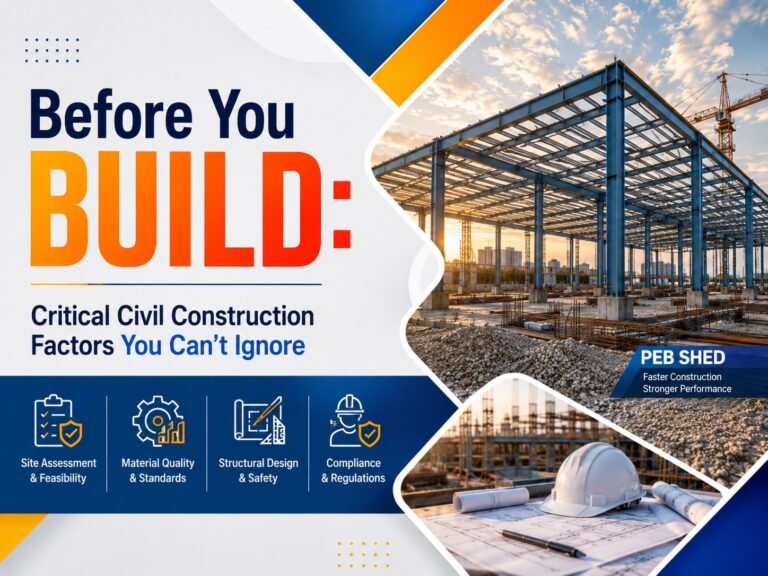
Before You Build: Critical Civil Construction Factors You Can’t Ignore
Have you ever seen a building project that started with excitement but ended in delays, budget overruns, or structural problems? It happens more often than people think. Many construction projects fail not because of poor materials, but because critical civil construction factors were ignored in the beginning.
Whether it is an industrial warehouse, factory shed, commercial building, or large infrastructure project, success starts long before the first brick is laid. Planning, soil testing, design accuracy, budgeting, safety standards, and choosing the right construction partner all play a major role in the outcome.
In today’s fast-growing construction industry, especially in India, businesses are investing heavily in industrial sheds, warehouses, pre-engineered buildings (PEB), and infrastructure development. But rushing into construction without understanding the essential factors can lead to major losses in time, money, and quality.
This guide explains the most important civil construction factors you should never ignore before starting a project. From site selection to project execution, you’ll learn how proper planning creates stronger, safer, and more cost-effective structures.
Understanding Civil Construction and Why It Matters
Civil construction refers to the process of designing, building, and maintaining infrastructure projects such as buildings, roads, warehouses, bridges, industrial sheds, and commercial facilities. It combines engineering, planning, architecture, and project management to create durable structures.
In India and around the world, civil construction is essential for economic growth. Industrial development, smart cities, logistics parks, and manufacturing hubs all depend on strong construction systems.
Modern civil construction focuses on:
- Structural strength
- Safety compliance
- Faster execution
- Cost optimization
- Sustainability
- Long-term durability
Without proper civil construction planning, even expensive projects can face serious structural and financial issues.
Why Early Planning Is the Foundation of Every Successful Project
One of the biggest mistakes in construction is starting too quickly without proper planning.
Many project owners focus only on completing construction fast. But experienced civil engineers know that strong planning saves both time and money in the long run.
Before construction begins, important decisions must be finalized, including:
- Project goals
- Site conditions
- Budget allocation
- Material requirements
- Construction timeline
- Legal approvals
- Structural design
A well-planned project reduces delays, prevents unnecessary expenses, and improves construction quality.
For example, industrial construction projects in India often face delays because land conditions, drainage systems, or utility connections were not studied in advance.
Good planning creates smoother execution.
Site Selection: The First Critical Decision
Choosing the right site is one of the most important civil construction factors.
A poor location can increase construction costs, create drainage problems, and reduce the long-term value of the project.
Important Factors to Check Before Site Selection
Soil Strength
Soil testing helps engineers understand whether the land can safely support the structure. Weak soil may require additional foundation work.
Water Drainage
Improper drainage can cause waterlogging, foundation damage, and erosion over time.
Accessibility
Industrial and commercial projects need proper road access for transportation and logistics.
Utility Availability
Electricity, water supply, sewage systems, and internet connectivity should be available nearby.
Environmental Conditions
Climate, rainfall, seismic zones, and flood risks must be analyzed carefully.
In India, many warehouse and factory projects are now being developed near industrial corridors because of better transportation and infrastructure facilities.
Soil Testing and Foundation Analysis
A building is only as strong as its foundation.
Soil investigation is a crucial step before construction starts. It helps engineers determine:
- Soil bearing capacity
- Moisture levels
- Ground stability
- Risk of settlement
- Foundation requirements
Ignoring soil analysis can lead to:
- Cracks in walls
- Uneven flooring
- Structural instability
- Water seepage
- Increased repair costs
Different soil types require different foundation systems. For example:
| Soil Type | Recommended Foundation |
|---|---|
| Rocky Soil | Shallow Foundation |
| Clay Soil | Deep Foundation |
| Sandy Soil | Reinforced Foundation |
| Loose Soil | Pile Foundation |
Professional civil construction companies always perform detailed geotechnical investigations before project execution.
Budget Planning: Avoiding Hidden Construction Costs
Construction projects often exceed budgets because of poor financial planning.
A realistic construction budget should include:
- Material costs
- Labor charges
- Equipment rental
- Transportation
- Government approvals
- Safety measures
- Unexpected expenses
One common issue in industrial construction is underestimating raw material price fluctuations. Steel, cement, and fuel prices can change rapidly.
Smart Budgeting Tips
Create a Contingency Fund
Keep at least 10–15% extra for unexpected expenses.
Prioritize Quality Materials
Cheap materials may reduce initial costs but increase future maintenance expenses.
Work With Experienced Contractors
Professional contractors help reduce material wastage and project delays.
Use Modern Construction Technology
PEB structures and prefabricated systems often reduce labor and execution costs.
Budget planning should focus not only on construction expenses but also on long-term operational savings.
Choosing the Right Civil Construction Company
The success of a project depends heavily on the construction partner you choose.
An experienced civil construction company provides:
- Technical expertise
- Proper project management
- Safety compliance
- Faster execution
- Better quality control
What to Look for in a Construction Company
Industry Experience
Choose a company with experience in industrial, commercial, or infrastructure projects.
Portfolio of Completed Projects
Review past projects to understand quality standards.
Engineering Capability
Strong engineering teams improve structural reliability.
Safety Standards
Construction safety should always be a top priority.
Transparency
Clear communication helps avoid disputes and confusion during execution.
In India, the demand for turnkey civil construction services is increasing because businesses prefer a single company handling design, manufacturing, fabrication, and installation.
Structural Design and Engineering Accuracy
Strong design is the backbone of safe construction.
Structural engineering ensures that buildings can safely handle:
- Dead loads
- Live loads
- Wind pressure
- Earthquakes
- Environmental stress
Poor structural design can lead to:
- Weak load distribution
- Structural failure
- Higher maintenance costs
- Reduced lifespan
Importance of Modern Engineering Software
Today, engineers use advanced design software for:
- Structural analysis
- Load calculation
- 3D modeling
- Steel detailing
- Error detection
Accurate engineering reduces material wastage and improves project efficiency.
For industrial projects, pre-engineered building systems are becoming popular because they provide faster construction and optimized structural performance.
Material Selection: Quality Impacts Durability
Construction materials directly affect strength, durability, and maintenance costs.
Using low-quality materials may reduce initial expenses but increases future repair costs.
Important Construction Materials
Steel
Widely used in industrial and PEB structures because of strength and flexibility.
Cement
High-quality cement improves foundation durability.
Concrete
Proper concrete mix design is critical for structural stability.
Roofing Sheets
Weather-resistant roofing improves building lifespan.
Insulation Materials
Important for temperature control in warehouses and factories.
Why Material Testing Matters
Professional construction companies test materials for:
- Strength
- Corrosion resistance
- Durability
- Load-bearing capacity
Quality assurance prevents future structural issues.
Safety Standards in Civil Construction
Construction safety protects workers, engineers, equipment, and the final structure.
Unfortunately, many projects ignore safety protocols to save time or money.
This approach creates serious risks.
Essential Construction Safety Measures
- Worker safety training
- Protective equipment
- Site inspections
- Fire safety systems
- Emergency response planning
- Equipment maintenance
Industrial construction sites especially require strict safety compliance because of heavy machinery and steel fabrication work.
Safe construction environments improve productivity and reduce accidents.
The Growing Importance of PEB Structures in Modern Construction
Pre-engineered buildings (PEB) are transforming industrial construction worldwide.
PEB structures are factory-manufactured steel buildings designed for faster assembly and better efficiency.
Benefits of PEB Construction
Faster Project Completion
PEB projects are completed much faster than traditional construction.
Reduced Construction Costs
Optimized steel usage reduces expenses.
Flexible Design Options
PEB structures can be customized for warehouses, factories, showrooms, and commercial spaces.
Better Durability
Modern steel structures provide excellent long-term performance.
Lower Maintenance
High-quality steel reduces repair requirements.
In India, PEB construction is widely used in:
- Warehouses
- Manufacturing plants
- Logistics parks
- Cold storage facilities
- Industrial sheds
Businesses prefer PEB solutions because they reduce project timelines significantly.
Environmental and Sustainability Considerations
Modern construction must balance development with environmental responsibility.
Sustainable civil construction helps reduce environmental impact while improving energy efficiency.
Sustainable Construction Practices
Energy-Efficient Designs
Natural lighting and ventilation reduce electricity usage.
Recyclable Materials
Steel is highly recyclable and environmentally friendly.
Water Management Systems
Rainwater harvesting improves sustainability.
Waste Reduction
Efficient planning reduces construction waste.
Solar Integration
Industrial buildings increasingly use rooftop solar systems.
Green construction practices are becoming more important because governments and industries worldwide are focusing on sustainable development.
Common Mistakes People Make Before Starting Construction
Many construction problems happen because early warning signs are ignored.
Major Construction Mistakes
Skipping Soil Testing
This can create serious foundation problems later.
Hiring Cheap Contractors
Low-cost contractors may compromise quality and safety.
Ignoring Legal Approvals
Lack of permits can stop projects completely.
Poor Budget Estimation
Unexpected costs can delay completion.
Weak Project Management
Without proper coordination, timelines suffer.
Using Low-Quality Materials
Poor materials reduce structural life.
Avoiding these mistakes improves project success and reduces financial risks.
The Role of Technology in Civil Construction
Technology is changing the future of construction.
Modern civil construction companies now use advanced tools for better efficiency and accuracy.
Construction Technologies Improving the Industry
Building Information Modeling (BIM)
Improves planning and project visualization.
Drones
Used for site surveys and progress monitoring.
AI-Based Planning Tools
Help optimize project schedules and costs.
Prefabrication
Factory-built components reduce on-site work.
Smart Monitoring Systems
Track structural performance and maintenance needs.
Technology improves productivity, safety, and project management.
Why Turnkey Construction Solutions Are Becoming Popular
Businesses today want faster, simpler, and more organized project execution.
That is why turnkey construction solutions are growing rapidly.
In a turnkey model, one company handles:
- Design
- Engineering
- Fabrication
- Manufacturing
- Construction
- Installation
Benefits of Turnkey Civil Construction
- Better coordination
- Faster project completion
- Reduced communication gaps
- Improved quality control
- Lower management burden
This approach is especially useful for industrial and warehouse construction projects.
Conclusion
Construction is more than just building structures. It is about creating safe, durable, and efficient spaces that support long-term growth.
Before starting any project, understanding critical civil construction factors is essential. Site selection, soil testing, budgeting, engineering design, safety standards, material quality, and experienced project management all contribute to successful construction outcomes.
As industrial growth continues across India and worldwide, businesses are increasingly choosing advanced construction methods like PEB structures and turnkey project solutions for faster and smarter execution.
The best projects are never built in a hurry. They are built with planning, precision, and the right expertise.
If you are planning a warehouse, factory shed, commercial building, or industrial infrastructure project, taking the time to focus on these critical construction factors can save you from costly mistakes and ensure long-term success.