


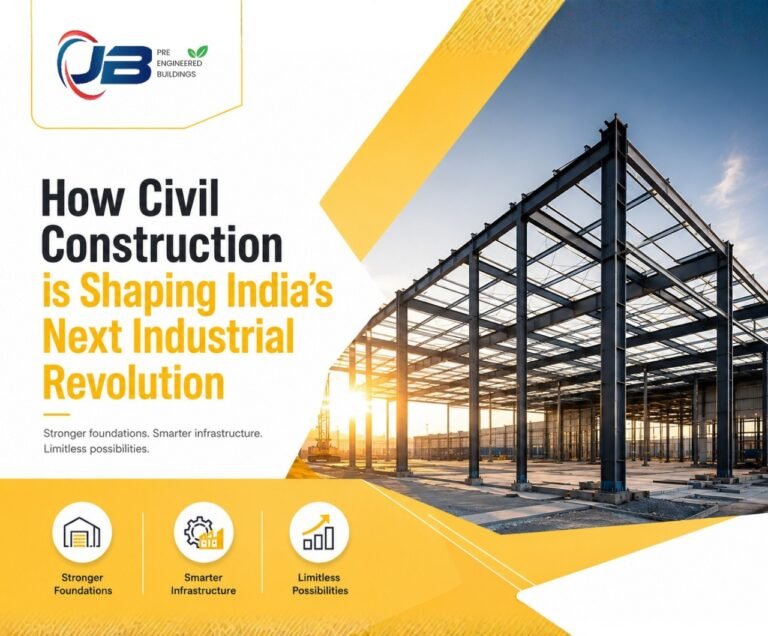
How Civil Construction is Shaping India’s Next Industrial Revolution
India is changing faster than ever before. New highways are stretching across states, massive warehouses are rising near industrial corridors, and modern factories are being built in cities that were once quiet towns. But have you ever wondered what is driving this transformation behind the scenes?
The answer lies in civil construction.
From industrial parks and logistics hubs to smart factories and pre-engineered buildings, civil construction is becoming the backbone of India’s next industrial revolution. It is not just about laying bricks and pouring concrete anymore. Today, construction is connected to technology, manufacturing, sustainability, employment, and economic growth.
As industries expand across India, the demand for strong infrastructure is growing rapidly. Businesses need modern warehouses, efficient manufacturing plants, durable steel structures, and faster project execution. Civil construction companies are helping make all of this possible.
In this article, we will explore how civil construction is shaping India’s industrial future, why it matters for businesses and communities, and how modern construction methods are changing the way industries grow.
Understanding Civil Construction in Modern India
Civil construction refers to the design, planning, development, and maintenance of infrastructure projects. These projects include factories, industrial sheds, roads, warehouses, commercial buildings, bridges, and public infrastructure.
In the past, construction mainly focused on traditional methods that took years to complete. Today, the industry has evolved with advanced engineering, steel structures, modular construction, and pre-engineered building solutions.
Modern civil construction in India now supports:
- Industrial manufacturing
- Logistics and warehousing
- Smart infrastructure
- Renewable energy projects
- Transportation networks
- Commercial and industrial expansion
The growth of civil construction is directly connected to India’s economic development. Without strong infrastructure, industries cannot operate efficiently.
Why India Is Entering a New Industrial Revolution
India is currently experiencing a major industrial transformation. Several factors are driving this growth:
Government Infrastructure Projects
Programs such as Make in India, PM Gati Shakti, Smart Cities Mission, and industrial corridor development are encouraging large-scale infrastructure expansion.
Rising Manufacturing Demand
Global companies are increasingly looking at India as a manufacturing hub. This has increased demand for industrial construction services, factory sheds, and logistics parks.
Growth of E-Commerce and Warehousing
The rise of online shopping has created massive demand for warehouses and distribution centers across India.
Technological Advancements
Automation, robotics, and smart manufacturing require modern industrial spaces designed for efficiency and scalability.
All of these factors are pushing civil construction companies to innovate faster than ever before.
The Role of Civil Construction in Industrial Growth
Civil construction is no longer just a support industry. It has become a strategic part of industrial development.
Building Industrial Infrastructure
Factories, industrial parks, warehouses, and logistics hubs require high-quality construction for long-term durability and operational efficiency.
Supporting Faster Expansion
Businesses want faster setup times. Modern civil construction methods help industries start operations quickly.
Improving Supply Chain Efficiency
Well-planned industrial infrastructure improves transportation, warehousing, and product movement across regions.
Creating Employment Opportunities
Construction projects generate jobs for engineers, architects, machine operators, technicians, and skilled laborers.
India’s industrial growth depends heavily on efficient and modern construction systems.
How Pre-Engineered Buildings Are Transforming Construction
One of the biggest changes in the industry is the rise of pre-engineered buildings (PEB).
PEB structures are steel buildings manufactured in factories and assembled on-site. These buildings are widely used for:
- Warehouses
- Manufacturing units
- Industrial sheds
- Cold storage facilities
- Commercial structures
- Aircraft hangars
Benefits of PEB Construction
Faster Construction Time
PEB projects can be completed much faster compared to traditional buildings.
Cost Efficiency
Optimized steel usage reduces material wastage and lowers construction costs.
High Durability
Modern steel structures are designed to handle harsh weather conditions and long-term industrial use.
Flexible Design
PEB structures can be customized for different industrial needs.
Low Maintenance
Steel buildings require less maintenance over time.
As industries look for faster and smarter solutions, PEB construction is becoming a preferred choice across India.
Smart Warehousing and Logistics Infrastructure
India’s logistics sector is expanding rapidly. With e-commerce, retail, and manufacturing growing together, the need for modern warehouses has increased significantly.
Civil construction companies are now designing warehouses with:
- Smart storage systems
- Automated loading zones
- High-load flooring
- Temperature-controlled environments
- Energy-efficient designs
Large logistics hubs near highways and industrial corridors are helping businesses improve delivery speed and inventory management.
This growth is especially visible in cities like:
- Delhi NCR
- Pune
- Ahmedabad
- Hyderabad
- Chennai
- Bengaluru
Modern warehousing is becoming a critical part of India’s industrial ecosystem.
Sustainable Construction Is Becoming the Future
Sustainability is now one of the most important trends in civil construction.
Industries are looking for eco-friendly building solutions that reduce environmental impact while improving efficiency.
Green Construction Practices Include:
- Solar-ready rooftops
- Rainwater harvesting systems
- Energy-efficient insulation
- Recyclable steel materials
- Natural lighting systems
- Waste reduction techniques
Steel structures and PEB buildings are often considered more sustainable because they reduce material waste and allow efficient recycling.
As environmental awareness grows, sustainable civil construction is becoming essential for future industrial projects.
Technology Is Changing the Construction Industry
Technology is revolutionizing modern civil construction in India.
Building Information Modeling (BIM)
BIM helps engineers and architects create digital models before actual construction begins.
Drones and Site Monitoring
Construction companies use drones for land surveys, inspections, and project monitoring.
Automation and Robotics
Advanced machinery helps improve speed and precision in industrial construction projects.
Smart Safety Systems
Digital safety monitoring improves worker protection and reduces construction risks.
Technology is helping construction companies deliver projects faster, safer, and more efficiently.
The Rise of Industrial Corridors in India
Industrial corridors are playing a major role in shaping India’s infrastructure future.
These corridors connect manufacturing hubs with transportation networks, ports, and logistics centers.
Some important industrial corridors include:
- Delhi-Mumbai Industrial Corridor (DMIC)
- Chennai-Bengaluru Industrial Corridor
- Amritsar-Kolkata Industrial Corridor
- Bengaluru-Mumbai Economic Corridor
Civil construction companies are heavily involved in developing:
- Roads
- Warehouses
- Factory buildings
- Utility infrastructure
- Industrial parks
These projects are expected to boost industrial production and create millions of jobs in the coming years.
How Civil Construction Supports Small and Medium Industries
Large corporations are not the only beneficiaries of industrial construction growth.
Small and medium enterprises (SMEs) are also gaining access to:
- Affordable industrial sheds
- Flexible warehouse spaces
- Shared logistics infrastructure
- Faster construction solutions
Pre-engineered buildings have made industrial expansion more affordable for smaller businesses.
Today, even medium-sized manufacturers can build modern facilities without spending years on traditional construction.
This is helping local industries grow across multiple states in India.
Challenges Facing the Civil Construction Industry
Despite rapid growth, the industry also faces several challenges.
Rising Material Costs
Steel, cement, and fuel price fluctuations impact project budgets.
Skilled Labor Shortage
The industry needs more trained engineers, technicians, and skilled workers.
Project Delays
Weather conditions, approvals, and supply chain issues can delay construction timelines.
Environmental Regulations
Companies must comply with sustainability and environmental standards.
Urban Expansion Pressure
Rapid urbanization increases demand for faster infrastructure development.
Construction companies that adopt innovation and better planning are better equipped to overcome these challenges.
Why Quality Construction Matters for Long-Term Growth
Poor construction can lead to operational problems, safety risks, and high maintenance costs.
High-quality civil construction provides:
- Better structural safety
- Longer building lifespan
- Lower repair costs
- Improved industrial productivity
- Better return on investment
Industries today want buildings that are not only strong but also efficient and future-ready.
This is why experienced civil construction and PEB companies are becoming important partners in industrial development.
India’s Infrastructure Boom and Global Opportunities
India is attracting global attention for its infrastructure growth.
International companies are investing in:
- Manufacturing plants
- Data centers
- Logistics parks
- Renewable energy facilities
- Industrial zones
Modern civil construction is helping India compete globally as a manufacturing and industrial hub.
The country’s focus on infrastructure development is expected to create long-term opportunities for businesses, investors, engineers, and construction companies.
As global supply chains shift, India’s construction sector will play a major role in shaping the future economy.
The Future of Civil Construction in India
The future of civil construction looks highly promising.
Over the next decade, the industry is expected to focus on:
Faster Project Execution
Businesses will continue demanding quicker construction timelines.
Smart Industrial Buildings
Automation-friendly structures will become more common.
Sustainable Infrastructure
Green construction practices will become standard.
Advanced Steel Structures
PEB technology and modular construction will expand rapidly.
Digital Construction Management
AI, BIM, and data-driven planning will improve efficiency.
India’s next industrial revolution will depend heavily on modern infrastructure and advanced construction systems.
Conclusion
India’s industrial future is being built one structure at a time.
Civil construction is no longer just about buildings and roads. It is now a powerful force driving industrial growth, economic development, job creation, and technological progress across the country.
From modern warehouses and factory sheds to sustainable steel structures and smart industrial corridors, construction companies are helping shape a stronger and more connected India.
As industries continue to grow, the demand for faster, smarter, and more durable infrastructure will only increase. Companies that invest in advanced civil construction and pre-engineered building solutions will be better prepared for the future.
India’s next industrial revolution is already underway — and civil construction is at the center of it.