

PEB Sheds vs Conventional Steel Structures: Which Is Better?
Introduction
Imagine you are planning a new warehouse, factory, logistics center, or industrial facility. One major decision can shape your project timeline, budget, and long-term operational efficiency:
Should you choose a PEB shed or a conventional steel structure?
This decision impacts construction speed, cost, design flexibility, maintenance, and future expansion.
Over the last decade, industrial construction has changed rapidly. Businesses today need faster project delivery, smarter engineering, and cost-effective infrastructure. That is why Pre-Engineered Buildings (PEB) have become a preferred choice across industries.
But conventional steel structures still remain popular for many complex and specialized projects.
So which one is better?
The answer depends on your project requirements.
This detailed guide explains everything you need to know.
What Is a PEB Shed?
A PEB shed is a pre-designed steel building system manufactured in a factory and assembled at the site.
PEB stands for Pre-Engineered Building.
These structures are engineered using advanced design software, where each component is optimized for load, performance, and efficiency.
Typical PEB components include:
- Primary steel frames
- Secondary members
- Roofing sheets
- Wall cladding
- Insulation systems
- Accessories
PEB sheds are widely used for:
- Warehouses
- Factories
- Cold storage
- Commercial buildings
- Aircraft hangars
- Industrial sheds
Practical Example:
A logistics company needing a 50,000 sq. ft. warehouse can complete construction much faster using a PEB shed compared to traditional steel structures.
What Is a Conventional Steel Structure?
A conventional steel structure is a building system where steel members are fabricated and assembled using traditional engineering and construction methods.
Unlike PEB systems, these structures use standard hot-rolled steel sections.
They are commonly designed individually for each project.
Applications include:
- Multi-story buildings
- Bridges
- Heavy industrial plants
- Complex infrastructure projects
Conventional steel structures are suitable for projects requiring:
- Custom geometry
- Heavy load handling
- Specialized engineering
Key Difference Between PEB and Conventional Steel Structures
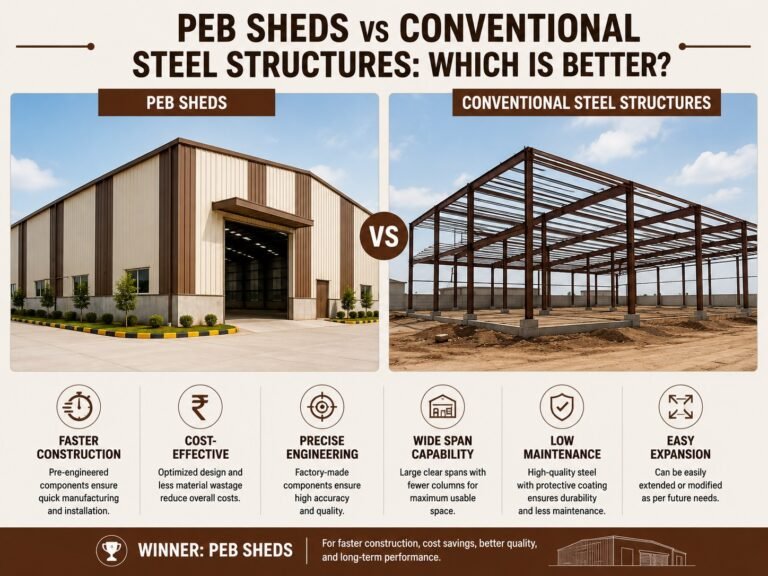
PEB focuses on efficiency, speed, and cost optimization, while conventional steel structures focus on flexibility and heavy-duty engineering.
| Feature | PEB Shed | Conventional Steel Structure |
|---|---|---|
| Design | Pre-engineered | Custom-designed |
| Construction Speed | Fast | Slower |
| Cost | Lower | Higher |
| Weight | Lightweight | Heavy |
| Maintenance | Lower | Higher |
| Expansion | Easy | Moderate |
| Customization | Moderate | High |
Cost Comparison: Which Is More Affordable?
PEB sheds are usually more cost-effective than conventional steel structures.
Why?
PEB buildings reduce costs in multiple ways:
- Lower steel usage
- Reduced labor cost
- Faster installation
- Less wastage
- Lower foundation cost
Cost Breakdown
| Cost Factor | PEB Shed | Conventional Steel |
|---|---|---|
| Material Cost | Lower | Higher |
| Labor Cost | Lower | Higher |
| Construction Time | Short | Long |
| Maintenance | Lower | Moderate |
For most industrial projects, PEB can reduce overall construction costs by 10–30%.
Which Offers Faster Construction?
PEB sheds are significantly faster to construct.
Since most components are fabricated in a factory, site work becomes easier and faster.
Typical timeline:
- PEB shed: 6–12 weeks
- Conventional steel structure: 4–8 months
This makes PEB ideal for businesses with urgent infrastructure needs.
Example:
A manufacturing company needing immediate operational capacity can benefit greatly from PEB construction.
Strength and Durability Comparison
Both are durable, but suitability depends on project type.
PEB sheds provide excellent durability for:
- Warehouses
- Industrial units
- Commercial spaces
Conventional steel structures perform better in:
- Heavy-duty industrial plants
- Complex infrastructure
- High-load facilities
Both can last 30–50+ years with proper maintenance.
Design Flexibility: Which Offers More Customization?
Conventional steel structures offer more design flexibility.
They are better for:
- Unique architectural designs
- Heavy equipment support
- Complex layouts
PEB sheds are also customizable but within optimized engineering limits.
PEB works well for:
- Large clear spans
- Open layouts
- Industrial designs
Maintenance Requirements
PEB sheds usually require lower maintenance.
Reasons include:
- Better corrosion-resistant coatings
- Optimized material use
- Modern roofing systems
Conventional steel structures may require:
- More inspections
- Frequent repainting
- Higher maintenance costs
This matters for long-term ownership cost.
Energy Efficiency Comparison
PEB sheds are generally more energy efficient.
Modern PEB designs can include:
- Thermal insulation
- Solar roofing
- Ventilation systems
- Natural lighting panels
Benefits:
- Lower electricity bills
- Better temperature control
- Sustainable operations
This makes PEB attractive for eco-conscious businesses.
Best Applications for PEB Sheds
PEB sheds are ideal for projects requiring speed, efficiency, and affordability.
Best applications:
- Industrial sheds
- Warehouses
- Logistics centers
- Agricultural storage
- Commercial buildings
- Distribution hubs
PEB is the preferred choice for growing businesses needing quick infrastructure.
Best Applications for Conventional Steel Structures
Conventional steel structures are better for complex and heavy-duty projects.
Best applications:
- Power plants
- Refineries
- Multi-story buildings
- Bridges
- Specialized industrial plants
These projects require advanced structural engineering.
Which Is Better for Future Expansion?
PEB sheds are better for expansion.
Many industries grow quickly.
PEB structures make it easier to:
- Add bays
- Extend length
- Increase capacity
This provides long-term flexibility for businesses.
Why Businesses Prefer PEB Today
Industry trends show strong growth in PEB adoption worldwide.
Why?
- Faster delivery
- Lower costs
- Better efficiency
- Easier scalability
- Modern engineering
Sectors using PEB rapidly:
- E-commerce
- Manufacturing
- Logistics
- Retail
- Agriculture
PEB has become the future of industrial construction.
Why Choose Jai Bharat PEB?
At Jai Bharat PEB, we specialize in delivering advanced steel building solutions for industrial and commercial projects.
Our services include:
- Design & Engineering
- Fabrication
- Installation
- Project Management
- Quality Assurance
Why clients choose us:
- Experienced engineering team
- High-quality steel solutions
- Timely project delivery
- Cost-effective construction
- End-to-end support
We help businesses build smarter, faster, and stronger.
Final Verdict: Which Is Better?
For most industrial and warehouse applications, PEB sheds are the better choice.
Choose PEB if you need:
- Faster construction
- Lower cost
- Easy expansion
- Better efficiency
Choose conventional steel structures if you need:
- Highly customized design
- Complex engineering
- Heavy-duty load capacity
The right choice depends on your project goals.
But for modern industrial infrastructure, PEB is increasingly becoming the preferred solution.
PEB Sheds vs Conventional Steel Structures Frequently Asked Questions
Are PEB sheds cheaper than conventional steel structures?
Yes, PEB sheds are generally more cost-effective because they reduce material waste, labor costs, and construction time.
Which lasts longer, PEB or conventional steel?
Both can last decades with proper maintenance. Durability depends on design quality and environmental conditions.
Are PEB sheds suitable for warehouses?
Yes. PEB sheds are widely used for warehouses because they offer large spans and faster construction.
Can PEB sheds be expanded later?
Yes. Expansion is one of the major advantages of PEB structures.
Which is better for industrial buildings?
For most industrial applications, PEB sheds provide better speed, efficiency, and cost savings.
Conclusion
Choosing between PEB sheds and conventional steel structures is an important business decision.
PEB sheds deliver speed, cost savings, scalability, and efficiency.
Conventional steel structures offer advanced flexibility for specialized projects.
The best choice depends on your goals, budget, and project complexity.
As industrial construction evolves, businesses increasingly prefer smarter solutions.
And for many, that solution is PEB.