


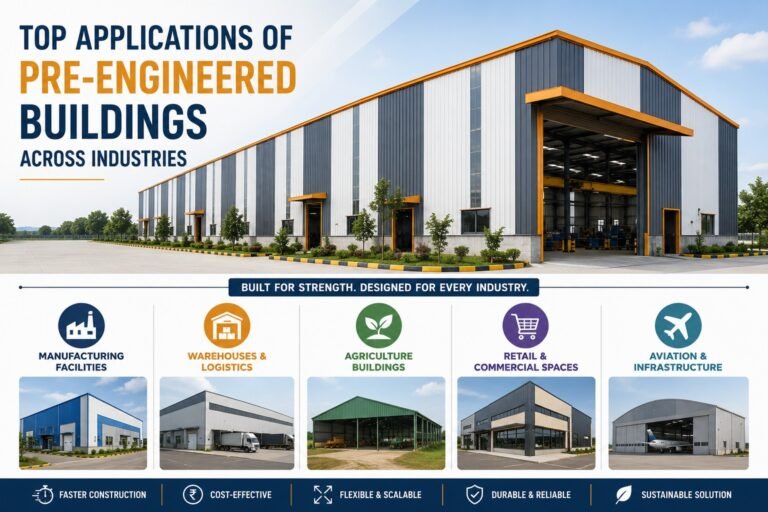
Top Applications of Pre-Engineered Buildings Across Industries
Introduction
Imagine building a large industrial warehouse, manufacturing plant, or logistics center in nearly half the time required by traditional construction.
Sounds impossible?
That is exactly why Pre-Engineered Buildings (PEB) are transforming construction worldwide.
From manufacturing facilities in the USA to logistics hubs in India, pre-engineered buildings have become the preferred choice for businesses seeking faster construction, lower costs, durability, and scalability.
Today, industries are evolving rapidly. Businesses need infrastructure that is flexible, cost-efficient, and future-ready. Traditional brick-and-concrete construction often struggles to keep up with modern operational demands.
This is where PEB structures deliver unmatched value.
A Pre-Engineered Building (PEB) is a steel-based building system designed and manufactured in a factory and assembled on-site. These buildings are customized for specific operational requirements, reducing construction time while improving structural efficiency.
Industries across the world are now choosing PEBs for:
- Industrial warehouses
- Manufacturing plants
- Cold storage facilities
- Commercial complexes
- Agricultural storage
- Aviation hangars
- Retail spaces
- Sports arenas
In this guide, we will explore the top applications of pre-engineered buildings across industries, their benefits, and why businesses are shifting toward PEB solutions.
What Are Pre-Engineered Buildings?
Pre-engineered buildings are steel structures designed, fabricated, and manufactured off-site before being assembled at the project location.
Detailed Explanation
PEB systems typically include:
- Primary framing
- Secondary framing
- Roofing systems
- Wall cladding
- Insulation
- Mezzanine floors
- Accessories
Unlike conventional buildings, every component is engineered for optimized load-bearing and efficient assembly.
Key Benefits of PEB Structures
| Feature | PEB Buildings | Traditional Buildings |
|---|---|---|
| Construction Time | Fast | Slow |
| Cost | Lower | Higher |
| Maintenance | Low | Moderate |
| Expansion | Easy | Difficult |
| Durability | High | Moderate |
Why Are Industries Choosing PEB Structures?
Industries prefer PEB buildings because they offer faster delivery, lower costs, superior durability, and scalable design.
Major Advantages
- Faster project completion
- Lower labor cost
- Minimal material wastage
- Better energy efficiency
- Long lifespan
- Earthquake resistance
- Flexible design
PEBs are especially valuable in sectors where speed and efficiency directly impact profitability.
1. Industrial Warehouses
PEBs are widely used for industrial warehouses because they provide large column-free spaces ideal for storage and logistics operations.
Warehousing is one of the biggest applications of pre-engineered buildings.
Modern warehouses require:
- Large storage capacity
- Efficient material movement
- High roof clearance
- Durable flooring support
PEBs provide all of these.
Common Warehouse Applications
- E-commerce warehouses
- FMCG storage
- Raw material storage
- Distribution centers
Practical Example
A logistics company can establish a 50,000 sq. ft. warehouse using a PEB system much faster than traditional construction.
2. Manufacturing Facilities
Manufacturing plants use PEB structures for operational efficiency, durability, and optimized production layouts.
Factories need large open spaces for machinery, production lines, and workflow efficiency.
PEB buildings support:
- Heavy equipment loads
- Crane systems
- Large machinery installations
- Flexible floor layouts
Industries using manufacturing PEBs include:
- Automotive
- Textile
- Electronics
- Food processing
3. Logistics & Distribution Centers
PEB buildings are ideal for logistics centers due to fast construction and optimized operational layouts.
Global supply chains demand efficient distribution networks.
PEBs help logistics companies build:
- Sorting centers
- Delivery hubs
- Regional distribution facilities
Benefits include:
- Faster expansion
- High loading bay efficiency
- Better truck movement planning
4. Cold Storage Facilities
PEB structures support cold storage projects by offering insulation-friendly designs and durable structural performance.
Cold storage requires precise environmental control.
PEBs support:
- Insulated roofing
- Temperature control systems
- Refrigeration infrastructure
Industries using cold storage PEBs:
- Food industry
- Dairy industry
- Pharmaceuticals
5. Agricultural Buildings
Agriculture businesses use PEBs for storage, livestock shelters, and equipment housing.
Agricultural infrastructure requires durability and weather resistance.
PEB applications in agriculture include:
- Grain storage
- Poultry sheds
- Dairy shelters
- Farm equipment storage
Why farmers choose PEBs:
- Weather-resistant
- Low maintenance
- Cost-effective
6. Commercial Complexes
PEBs are increasingly used in commercial construction because of speed, flexibility, and modern architectural capabilities.
Commercial applications include:
- Office spaces
- Business parks
- Commercial complexes
- Showrooms
Modern PEB designs now offer excellent architectural appeal.
7. Retail Buildings
Retail brands use PEB buildings for fast setup and cost-effective commercial expansion.
Retail businesses need faster market entry.
PEBs help businesses launch:
- Supermarkets
- Hypermarkets
- Brand outlets
- Retail chains
Benefits
- Faster store launch
- Lower construction cost
- Scalable layouts
8. Aviation Hangars
PEB structures are ideal for aviation hangars due to large clear spans and superior structural strength.
Aircraft hangars require:
- Large clear spans
- High roof heights
- Strong structural systems
PEBs provide these efficiently.
Applications include:
- Commercial aviation
- Defense
- Private aviation
9. Sports Facilities
PEBs are widely used for sports facilities because they offer large uninterrupted spaces.
Examples include:
- Indoor stadiums
- Sports complexes
- Training centers
- Gymnasiums
Advantages:
- Wide span designs
- Faster completion
- Lower maintenance
10. Educational Institutions
Quick Answer
Educational institutions use PEB structures for fast infrastructure development.
Applications include:
- School buildings
- Auditoriums
- Labs
- Training centers
Growing institutions benefit from quick expansion.
11. Healthcare Infrastructure
Healthcare facilities use PEB systems for rapid infrastructure development.
Applications:
- Diagnostic centers
- Emergency hospitals
- Healthcare units
- Labs
PEBs became highly relevant for emergency infrastructure expansion.
12. Infrastructure & Government Projects
Governments use PEBs for rapid construction of essential public infrastructure.
Applications include:
- Metro depots
- Bus terminals
- Public facilities
- Disaster relief shelters
These projects benefit from fast deployment.
Industry-Wise PEB Application Comparison
| Industry | Main Use | Key Benefit |
|---|---|---|
| Warehousing | Storage | Large clear spans |
| Manufacturing | Production | Heavy load capacity |
| Logistics | Distribution | Operational efficiency |
| Agriculture | Storage | Cost-effective |
| Retail | Commercial | Fast setup |
| Aviation | Hangars | Large open spaces |
Why Choose a Professional PEB Shed Manufacturer?
Choosing an experienced PEB shed manufacturer ensures better design quality, structural safety, and long-term performance.
An experienced manufacturer provides:
- Engineering expertise
- Quality steel
- Accurate fabrication
- On-time installation
- Compliance with standards
Trust Signals to Look For
- Industry experience
- Certifications
- Completed projects
- Strong client portfolio
- Engineering team
Case Study Example
A leading logistics company needed a large distribution center within a tight deadline.
Traditional construction estimate: 12–15 months
PEB solution timeline: 6–8 months
Result:
- Faster operational launch
- Reduced construction costs
- Improved ROI
This demonstrates why industries increasingly prefer PEB structures.
Future of Pre-Engineered Buildings
The future of PEB construction looks highly promising.
Emerging trends include:
- Smart industrial buildings
- Sustainable steel construction
- Green energy integration
- Solar-ready roofing
- AI-driven building design
By 2030, PEB systems are expected to dominate industrial and commercial construction worldwide.