


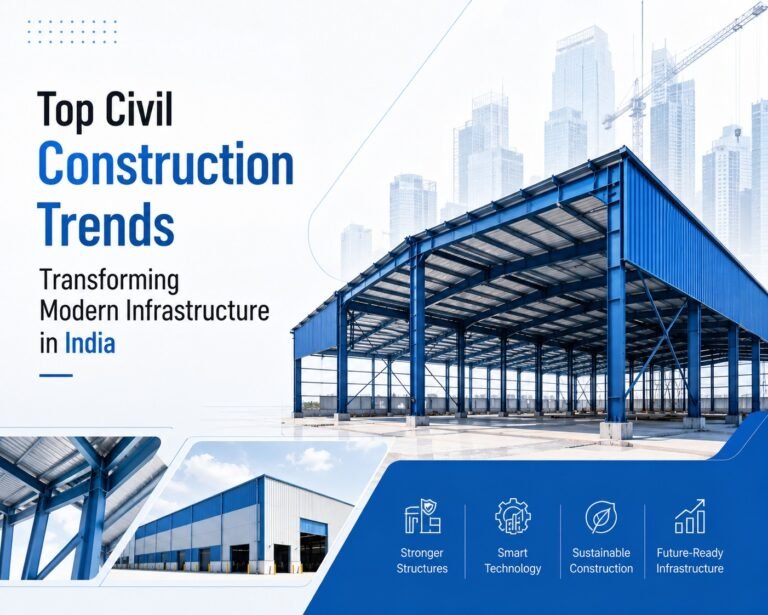
Top Civil Construction Trends Transforming Modern Infrastructure in India
India is building faster than ever before. From massive highways and smart cities to industrial corridors and green commercial spaces, the country is witnessing a construction revolution that is reshaping the future of infrastructure. But have you ever wondered what is driving this rapid transformation?
The answer lies in modern civil construction trends.
Today’s construction industry is no longer limited to bricks, cement, and steel. It now includes smart technologies, sustainable materials, digital planning, modular systems, automation, and energy-efficient designs. Across India, builders, engineers, architects, and infrastructure companies are adopting advanced solutions to create stronger, faster, safer, and more sustainable projects.
As urban populations continue to grow and industries expand, the demand for modern infrastructure in India is increasing rapidly. Government initiatives like Smart Cities Mission, Make in India, Bharatmala Project, and industrial development programs are also pushing the civil construction sector toward innovation and modernization.
In this article, we will explore the top civil construction trends transforming modern infrastructure in India, understand how they are changing the industry, and discover what the future holds for construction businesses, industries, and communities.
What Is Modern Civil Construction?
Modern civil construction refers to the use of advanced engineering methods, technologies, materials, and project management systems to develop infrastructure efficiently and sustainably.
Unlike traditional construction methods, modern civil construction focuses on:
- Faster project execution
- Smart planning and automation
- Sustainable building practices
- Improved safety standards
- Cost-efficient development
- Long-lasting infrastructure
Civil construction includes the development of:
- Roads and highways
- Industrial buildings
- Warehouses
- Airports
- Bridges
- Residential projects
- Commercial buildings
- Smart cities
- Factories and industrial parks
India’s infrastructure growth has made civil construction one of the country’s fastest-growing sectors.
The Rapid Growth of Infrastructure Development in India
India is currently one of the world’s largest infrastructure markets. The government and private sector are investing heavily in transportation, industrial development, renewable energy, and urban infrastructure.
Several factors are driving this growth:
Urban Expansion
Millions of people are moving to cities every year, increasing the need for roads, housing, water systems, and commercial spaces.
Industrial Development
Manufacturing and logistics sectors are growing rapidly, leading to increased demand for factories, warehouses, and industrial sheds.
Government Infrastructure Projects
Projects like:
- Smart Cities Mission
- PM Gati Shakti
- Bharatmala Pariyojana
- Dedicated Freight Corridors
are transforming transportation and urban connectivity across India.
Foreign Investments
Global companies are investing in India’s infrastructure and industrial sectors, encouraging advanced construction practices.
Rise of Pre-Engineered Buildings (PEB) in India
One of the biggest civil construction trends in India is the increasing use of Pre-Engineered Buildings (PEB).
PEB structures are factory-made steel buildings designed for quick assembly at construction sites. These structures are widely used for:
- Warehouses
- Industrial sheds
- Factories
- Commercial spaces
- Logistics parks
- Agricultural buildings
Why PEB Construction Is Growing Fast
Faster Construction Time
PEB projects can be completed much faster compared to traditional concrete structures.
Lower Construction Costs
Factory manufacturing reduces material waste and labor costs.
Flexible Design Options
PEB structures can be customized according to industrial and commercial requirements.
High Durability
Modern steel structures are strong, corrosion-resistant, and designed for long-term use.
Sustainable Construction
PEB buildings use recyclable materials and reduce environmental impact.
Today, many industrial construction companies in India prefer PEB solutions for faster infrastructure development.
Sustainable and Green Construction Practices
Sustainability is becoming a major focus in modern civil construction.
Construction companies are now adopting eco-friendly practices to reduce pollution, energy use, and environmental damage.
Popular Green Construction Trends
Energy-Efficient Buildings
Modern structures are designed to reduce electricity consumption using:
- Natural lighting
- Ventilation systems
- Solar panels
- Smart cooling systems
Use of Recyclable Materials
Steel, aluminum, and recycled concrete are increasingly being used in infrastructure projects.
Water Conservation Systems
Rainwater harvesting and wastewater recycling are becoming common in commercial and industrial construction.
Green Certifications
Builders now aim for certifications such as:
- LEED Certification
- IGBC Green Building Rating
These certifications improve environmental performance and building value.
Sustainable civil construction is becoming essential for future-ready infrastructure in India.
Smart Construction Technology Is Changing the Industry
Technology is transforming the construction industry faster than ever before.
Modern civil construction companies are using advanced digital tools to improve project accuracy, speed, and efficiency.
Building Information Modeling (BIM)
BIM allows engineers and architects to create detailed 3D models before construction begins.
Benefits include:
- Better planning
- Reduced errors
- Improved collaboration
- Lower project delays
Drones in Construction
Drones are now used for:
- Land surveys
- Site inspections
- Progress tracking
- Safety monitoring
This helps save time and improve project management.
Artificial Intelligence and Automation
AI tools help construction companies predict project risks, manage resources, and improve timelines.
Automation also improves productivity and reduces labor-intensive tasks.
Smart Sensors and IoT
IoT-based sensors monitor:
- Structural performance
- Temperature
- Equipment health
- Energy consumption
This improves safety and long-term maintenance.
Modular Construction and Prefabrication Trends
Modular construction is becoming highly popular in India’s infrastructure sector.
In this method, building components are manufactured off-site and assembled later at the project location.
Advantages of Modular Construction
Faster Project Completion
Multiple construction activities can happen simultaneously.
Better Quality Control
Factory manufacturing ensures precision and consistency.
Reduced Waste
Material usage becomes more efficient.
Improved Safety
Controlled manufacturing environments reduce construction risks.
Prefabricated structures are now widely used in:
- Hospitals
- Schools
- Industrial buildings
- Site offices
- Residential projects
Growth of Industrial and Warehouse Construction
India’s logistics and manufacturing sectors are expanding rapidly, increasing the demand for industrial construction services.
Key Factors Driving Warehouse Construction
E-commerce Growth
Online shopping has created huge demand for storage and distribution centers.
Supply Chain Expansion
Companies need modern warehouses for inventory management and logistics.
Industrial Corridors
Government-backed industrial zones are encouraging factory and warehouse development.
Demand for Large Industrial Sheds
PEB warehouses and industrial sheds are becoming preferred choices because of their speed and affordability.
Industrial infrastructure development is expected to remain one of the strongest construction sectors in India.
Smart Cities and Urban Infrastructure Development
India’s Smart Cities Mission is changing the future of urban living.
Smart cities focus on:
- Better transportation
- Smart utilities
- Digital infrastructure
- Sustainable housing
- Efficient waste management
Modern Construction Trends in Smart Cities
Smart Traffic Systems
Technology-driven traffic control improves urban mobility.
Integrated Public Infrastructure
Roads, drainage systems, and utilities are planned together for better efficiency.
Digital Monitoring Systems
CCTV surveillance, smart lighting, and IoT-based management systems improve city operations.
Green Public Spaces
Urban planning now includes parks, green corridors, and eco-friendly zones.
Civil construction companies are playing a major role in developing future-ready cities across India.
Advanced Construction Materials Improving Durability
Modern infrastructure requires materials that are stronger, lighter, and more durable.
Popular Advanced Construction Materials
High-Performance Concrete
This type of concrete provides better strength and durability.
Weather-Resistant Steel
Used in industrial structures and bridges for long-term protection.
Self-Healing Concrete
This innovative material repairs small cracks automatically.
Lightweight Construction Materials
These materials reduce structural load and improve efficiency.
The use of advanced materials improves infrastructure lifespan and lowers maintenance costs.
Focus on Construction Safety and Worker Welfare
Safety has become a major priority in modern civil construction.
Construction companies are adopting strict safety standards to protect workers and reduce accidents.
Important Safety Trends
Safety Training Programs
Workers receive regular training on equipment handling and emergency procedures.
Smart Safety Equipment
Modern helmets, sensors, and wearable devices improve worker protection.
Digital Site Monitoring
Cameras and AI systems help monitor construction activities in real time.
Improved Labor Facilities
Better housing, sanitation, and health facilities are being provided at construction sites.
Safe construction practices improve productivity and project quality.
Role of Digital Project Management in Civil Construction
Managing large infrastructure projects can be challenging. Digital project management tools are helping companies improve coordination and efficiency.
Benefits of Digital Construction Management
- Better communication
- Real-time progress tracking
- Resource optimization
- Budget monitoring
- Faster decision-making
Construction management software is now commonly used in industrial and commercial infrastructure projects.
Renewable Energy Infrastructure Is Expanding
India’s renewable energy sector is creating new opportunities for civil construction companies.
Large-scale projects include:
- Solar power plants
- Wind energy parks
- Green hydrogen facilities
- Battery storage infrastructure
These projects require specialized civil engineering and industrial construction expertise.
As India moves toward cleaner energy, sustainable infrastructure development will continue to grow.
Challenges Facing the Indian Civil Construction Industry
Despite rapid growth, the industry also faces several challenges.
Rising Material Costs
Steel, cement, and fuel prices can impact project budgets.
Skilled Labor Shortage
The industry needs more trained engineers, technicians, and skilled workers.
Environmental Regulations
Builders must comply with strict sustainability and environmental standards.
Project Delays
Land acquisition and approval processes sometimes slow infrastructure projects.
However, technology, automation, and better planning are helping overcome many of these challenges.
Future of Civil Construction in India
The future of civil construction in India looks highly promising.
Experts predict strong growth in:
- Smart infrastructure
- Green buildings
- Industrial construction
- High-speed transportation
- Sustainable urban development
- Digital construction technology
The construction industry is expected to become more automated, data-driven, and environmentally responsible in the coming years.
Companies that adopt innovation and modern construction practices will lead the next phase of infrastructure development in India.
Conclusion
India’s civil construction industry is entering a new era of innovation, sustainability, and smart infrastructure development. From Pre-Engineered Buildings and modular construction to AI-driven project management and green building practices, modern construction trends are transforming the way infrastructure is designed and built.
As industries grow and cities expand, the need for faster, stronger, and more sustainable infrastructure will continue to increase. Construction companies that embrace advanced technologies, sustainable practices, and efficient engineering solutions will play a major role in shaping India’s future.
Modern civil construction is not just about building structures anymore. It is about creating smart, durable, and future-ready infrastructure that supports economic growth, improves daily life, and strengthens the nation for generations to come.
Whether it is a warehouse, factory, smart city, or transportation network, the future of infrastructure in India is being built today — stronger, smarter, and faster than ever before.