


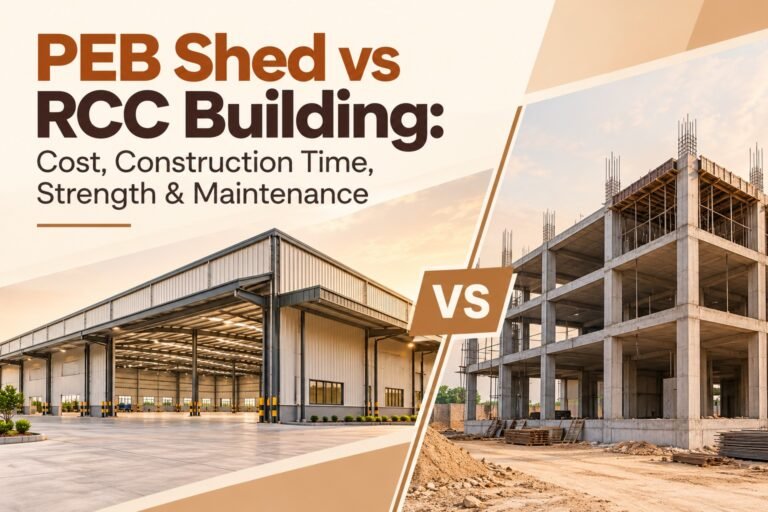
PEB Shed vs RCC Building: Cost, Construction Time, Strength & Maintenance
Introduction: Which Building System Is Right for Your Project?
Imagine planning a warehouse, factory, or industrial facility. You want a strong structure, a practical budget, and a building that is ready for operations as soon as possible. Two common options are a Pre-Engineered Building (PEB) shed and a Reinforced Cement Concrete (RCC) building.
Both offer important benefits, but they differ in construction methods, design flexibility, costs, and maintenance. Understanding the difference between a PEB shed vs RCC building helps you choose the right solution for your site and business needs.
1. What Is a PEB Shed?
A PEB shed is a steel building designed and engineered using planned specifications, with major structural components fabricated in a factory and assembled at the construction site.
PEB structures are widely used for warehouses, factories, logistics centres, workshops, and industrial buildings.
Key benefits:
- Faster on-site assembly.
- Large, open spaces with fewer internal columns.
- Flexible layouts and future expansion options.
- Reduced on-site construction work.
For example, a logistics company needing large storage and loading areas may benefit from a PEB warehouse.
2. What Is an RCC Building?
An RCC building uses reinforced cement concrete, combining concrete with steel reinforcement to resist different structural forces. Its columns, beams, slabs, and foundations are constructed according to the approved design.
RCC is commonly used for residential buildings, offices, hospitals, multistorey structures, and industrial facilities that require concrete floors or multiple levels.
Key benefits:
- Suitable for multistorey construction.
- Solid concrete floors and structural elements.
- Good fire resistance when properly designed.
- Wide applications across residential and commercial projects.
3. PEB Shed vs RCC Building: Quick Comparison
| Feature | PEB Shed | RCC Building |
|---|---|---|
| Main structure | Structural steel | Reinforced concrete |
| Construction speed | Generally faster | Generally slower |
| Large open spans | Often more practical | May require more columns or deeper beams |
| Multistorey use | Possible with suitable engineering | Commonly suitable |
| Foundation | Depends on loads and soil | Depends on loads and soil |
| Fire performance | Requires suitable fire protection | Concrete offers inherent fire resistance |
| Maintenance | Steel coating and corrosion checks | Crack, seepage, and concrete condition checks |
| Expansion | Often easier to extend | Can require more disruptive structural work |
The best option depends on the building design, site conditions, materials, labour, and intended use.
4. Which Is More Cost-Effective?
Quick answer: A PEB shed can be cost-effective for large-span warehouses and industrial buildings, but the final cost depends on the complete project scope.
PEB costs include structural steel, fabrication, transportation, erection, roofing, cladding, foundations, and civil work. RCC costs include cement, reinforcement steel, formwork, labour, concrete work, and curing.
Compare complete project quotations rather than only the price per square foot.
Practical tip: Request an itemised estimate covering foundations, flooring, insulation, fire safety, drainage, utilities, and finishing.
5. Which Takes Less Construction Time?
PEB construction is often faster because structural components are fabricated while site preparation and foundation work progress in parallel. RCC construction generally requires additional time for formwork, reinforcement, concrete placement, and curing.
Actual timelines depend on project size, weather, approvals, material availability, and workforce coordination.
6. Which Structure Is Stronger?
Neither system is automatically stronger in every situation. A properly engineered PEB structure can safely handle specified wind, seismic, and other design loads. An RCC building can also provide excellent structural performance when designed and constructed correctly.
The comparison must consider the building’s purpose, design loads, connections, material quality, foundation, and compliance with applicable codes.
7. Which Requires Less Maintenance?
PEB buildings need inspections of protective coatings, steel connections, fasteners, roof sheets, and drainage systems to manage corrosion and water leakage.
RCC buildings require checks for cracks, seepage, concrete deterioration, exposed reinforcement, and waterproofing issues.
Expert tip: Good design, quality materials, correct installation, and planned inspections help control maintenance costs in either system.
8. Which Is Better for Industrial Projects in India?
For warehouses, manufacturing units, logistics facilities, and large industrial sheds, PEB can be an effective choice because it supports wide spans and rapid assembly. RCC may be more suitable for multistorey buildings, specialised heavy-duty floors, or projects where concrete construction is preferred.
In industrial areas around Delhi NCR, including Sonipat, Gurgaon, and Faridabad, compare both systems against your operational requirements and local site conditions.
9. Why Consider Jai Bharat PEB?
Jai Bharat PEB provides PEB-related solutions for industrial buildings, warehouses, and manufacturing facilities. When evaluating a supplier or contractor, check their engineering process, fabrication capabilities, installation scope, project portfolio, quality procedures, and quotation transparency.
Explore Jai Bharat PEB to learn more about its services and industrial building solutions.
10. How to Choose the Right Building System
Before making a decision:
- Define the building’s use and required floor area.
- Assess clear-span, height, and future expansion needs.
- Compare itemised PEB and RCC quotations.
- Review soil conditions and foundation requirements.
- Check fire safety, insulation, drainage, and applicable building codes.
- Compare delivery schedules, warranties, and maintenance plans.
Conclusion
Choosing between a PEB shed vs RCC building comes down to your building’s purpose, budget, timeline, structural requirements, and long-term operating needs. PEB is often attractive for industrial sheds and warehouses, while RCC remains a strong option for multistorey and concrete-focused applications.
The smartest building decision is not simply the cheapest structure—it is the one engineered for your needs and designed to deliver value over its full service life