


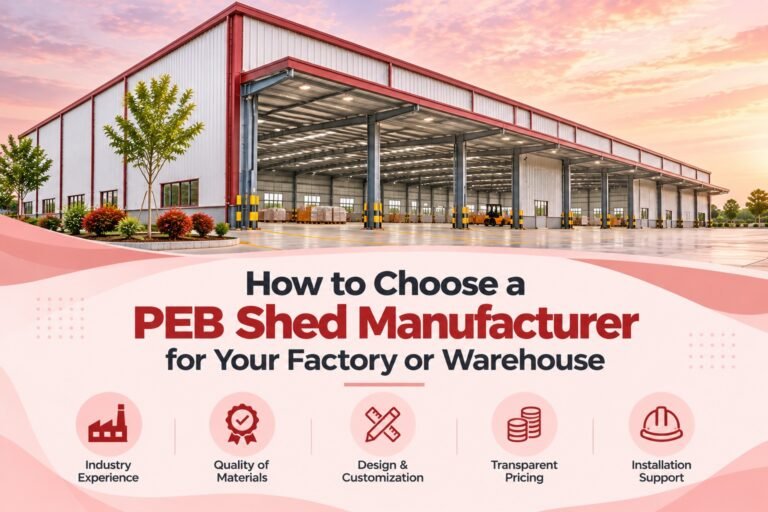
How to Choose a PEB Shed Manufacturer for Your Factory or Warehouse
Introduction: The Right Manufacturer Makes a Difference
Imagine investing in a new factory or warehouse, only to face construction delays, unexpected costs, or problems with the building design. These issues can affect production, storage, and business growth. Choosing the right PEB shed manufacturer for your factory or warehouse helps reduce these risks and supports a smoother construction process.
A pre-engineered building (PEB) is a steel structure designed and fabricated using planned engineering specifications, with components assembled at the project site. PEB buildings are commonly used for factories, warehouses, logistics centres, and industrial facilities because they can offer efficient construction and flexible layouts.
But how do you select the right supplier from the many PEB shed manufacturers in India? Here are the key factors to evaluate.
1. Check the Manufacturer’s Industry Experience
Quick answer: Choose a manufacturer with relevant experience in projects similar to yours.
A warehouse requires different planning from a manufacturing facility. Consider whether the company has handled similar building sizes, loading requirements, clear spans, and site conditions.
Practical tip: Ask for completed project examples, photographs, project locations, and references where available. A portfolio helps you understand the manufacturer’s actual capabilities.
2. Evaluate Design and Engineering Capabilities
Quick answer: Your PEB shed should be engineered for its intended use and site conditions.
Professional design considers building dimensions, roof slope, wind loads, seismic requirements, equipment loads, ventilation, and applicable building codes. The design should also account for future expansion where practical.
For example, a factory with overhead cranes may need a different structural design from a general storage warehouse.
Practical tip: Request structural drawings, design assumptions, and relevant engineering calculations before approving fabrication.
3. Compare Steel Quality and Manufacturing Standards
Quick answer: Evaluate material specifications, fabrication quality, and quality-control procedures—not just the quoted price.
Ask about steel grades, material traceability, welding procedures, corrosion protection, and inspection processes. The appropriate specifications depend on the building design and operating environment.
Practical tip: Compare written technical specifications and quality documents from each shortlisted PEB manufacturer.
4. Understand the Complete Project Cost
Quick answer: Compare itemised quotations with the same scope of work.
The lowest initial quotation may exclude important expenses such as foundations, flooring, drainage, transportation, insulation, electrical work, or installation.
| Cost component | What to check |
|---|---|
| Design and engineering | Drawings and structural calculations |
| Steel structure | Grades, quantities, coatings |
| Civil construction | Foundations, flooring, drainage |
| Roofing and cladding | Sheets, insulation, accessories |
| Installation | Labour, equipment, site assembly |
| Additional work | Electrical, fire safety, interiors |
Practical tip: Request a detailed quotation with inclusions, exclusions, taxes, payment milestones, and potential variation costs.
5. Check Installation and Project Management
Quick answer: A capable manufacturer should explain how fabrication, delivery, and site installation will be coordinated.
Even well-designed steel components require proper transport, lifting, alignment, bolting, and inspection. Delays can occur if materials, labour, equipment, or site readiness are not properly planned.
Ask for a project schedule, site responsibilities, and a clear process for handling changes.
6. Compare PEB Manufacturers and Contractors
Quick answer: Select a supplier based on your required project scope, not only the company’s marketing claims.
| Factor | PEB manufacturer | Turnkey contractor |
|---|---|---|
| Main responsibility | Fabrication and supply of PEB components | Coordinated delivery of agreed project scope |
| Civil work | May be excluded | Can be included |
| Installation | Depends on contract | Can be included |
| Project coordination | Varies | Often covers multiple work packages |
These roles can overlap. Always verify the actual contractual scope rather than relying on the company title alone.
7. Choose a Manufacturer That Offers Customisation
Quick answer: The building design should match your operations, equipment, storage needs, and expansion plans.
Consider clear height, column spacing, loading bays, skylights, ventilation, insulation, and future extensions. A distribution warehouse may prioritise truck movement, while a factory may require production lines and equipment foundations.
Practical tip: Share your operational requirements and site layout before requesting a final proposal.
8. Verify Safety, Compliance, and After-Sales Support
Quick answer: Confirm applicable approvals, safety requirements, warranties, and maintenance responsibilities in writing.
Check whether the proposed design addresses relevant local building regulations, structural standards, fire-safety requirements, and site-specific conditions. Ask what warranties cover and how defects or maintenance requests are handled.
Practical tip: Verify claimed certifications and references independently. Do not assume that every manufacturer holds the same approvals.
9. Why Consider Jai Bharat PEB?
Jai Bharat PEB, based in Sonipat, Haryana, provides PEB manufacturing and industrial construction solutions. Businesses evaluating a PEB shed manufacturer in India can explore its services for industrial sheds, warehouses, manufacturing facilities, and related construction requirements.
Before selecting any supplier, including Jai Bharat PEB, review relevant project examples, technical specifications, quotation details, and the scope of services offered.
10. Frequently Asked Questions About Choosing a PEB Shed Manufacturer
How do I choose the best PEB shed manufacturer in India?
Compare relevant project experience, engineering capability, steel specifications, itemised pricing, installation support, compliance, and warranties. Request written proposals from at least two or three qualified suppliers.
How much does a PEB shed cost?
The cost depends on building size, design loads, steel requirements, location, foundations, roofing, insulation, and installation scope. Request a project-specific quotation rather than relying on a generic price.
How long does PEB shed construction take?
Timelines depend on design approval, building size, fabrication capacity, site preparation, transportation, weather, and installation complexity. Ask the manufacturer for a project schedule with clear milestones.
Can a PEB shed be customised for a factory?
Yes. PEB buildings can be designed around operational requirements such as clear height, column spacing, equipment loads, ventilation, insulation, and future expansion, subject to engineering feasibility.
Should I choose a local PEB manufacturer?
A local supplier may simplify site visits, communication, and logistics. However, compare technical capability, project references, delivery costs, and installation support rather than choosing on location alone.
Conclusion: Make an Informed Investment
Choosing the right PEB shed manufacturer for your factory or warehouse requires more than comparing prices. Evaluate engineering, material quality, project experience, installation, compliance, and after-sales support before signing a contract.
For businesses planning industrial infrastructure in India, a clear scope of work and a technically sound design can help prevent costly surprises.
The best PEB partner is not necessarily the cheapest—it is the one that delivers the right building for your operational needs, budget, and long-term plans.